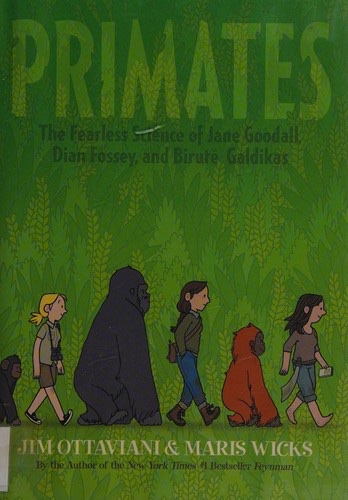
Cover of Primates

Primates

Jim Ottaviani and Maris Wicks

4 ideas

  1. Goodall sees chimpanzees make termite-fishing tools

    In 1960 at Gombe, Jane Goodall, untrained and without a degree, watched the chimpanzee she named David Greybeard strip leaves from twigs and use them to fish termites from a mound. The observation broke the accepted definition of humans as the only toolmakers, prompting Leakey's reply that science must now redefine tool, redefine man, or accept chimpanzees as humans.

  2. Outsiders chosen for patience over credentials

    Louis Leakey deliberately sent women with little or no formal scientific training into the field. His bet was that such observers came without theoretical preconceptions and had the patience to watch for years, so they would see behavior that credentialed researchers had filtered out.

  3. Naming individuals reveals personality and society

    Goodall gave the chimpanzees names instead of the numbers that scientific convention required, and she treated them as individuals with distinct personalities. Seeing each animal as someone rather than a sample made visible the family bonds, rivalries and individual temperaments that aggregate data hides. The cost was a charge of anthropomorphism, which she accepted as the price of seeing the social structure.

  4. Habituation requires years of harmless presence

    The three researchers gained access to wild apes through slow, patient exposure over long periods, not through clever technique. The animals' tolerance of the observer is the true research instrument, and it is built only by consistent, nonthreatening presence over time.

Save and mark ideas in the app