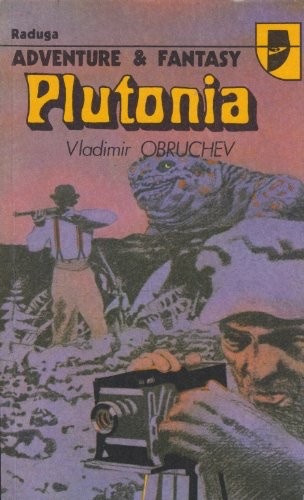
Cover of Plutonia

Plutonia

Vladimir Obruchev

4 ideas

  1. Polar Expedition Descends Through Living Geologic Eras

    A Russian scientific expedition led by the geologist Kashtanov sails into the Arctic north of the Bering Strait, finds an unmapped land, and descends through a vast opening into a hollow Earth lit by a dim red inner sun they name Pluto. Moving deeper into the interior, the party passes through successive regions: first mammoths and cave-dwelling humans, then older landscapes with giant reptiles, flying saurians, and primitive plants. They survive volcanic eruptions and hostile creatures and return to the surface with observations that the outside world has trouble accepting.

  2. Distance Traveled Maps Onto Geologic Time

    The interior is arranged so that each step farther from the entrance reaches an older period of Earth's history, in the same order found in the stratigraphic record: Quaternary, then Tertiary, then Mesozoic. The rock column, normally read vertically in cliffs and boreholes, is turned into a horizontal route. A journey through space becomes a tour of the fossil sequence, and the reader learns the order of the eras by crossing them.

  3. One Impossible Premise, Everything Else Rigorous

    The hollow Earth is granted, but the weak inner sun's light and heat, the climate, the vegetation, and the animals it supports are worked out from real geology and paleontology. The fantasy premise is only the delivery mechanism. The educational content comes from consistent detail downstream of that premise.

  4. Ecosystems as Era-Consistent Assemblages

    Each prehistoric zone is shown as a coherent community of plants and animals that actually lived together, with the vegetation, climate, and fauna matched to one period. This corrects the popular lost-world habit of mixing mammoths, dinosaurs, and cavemen into a single anachronistic scene. Seeing a fossil as a member of a time-specific assemblage, rather than as an isolated monster, changes what counts as a plausible picture of the past.

Save and mark ideas in the app