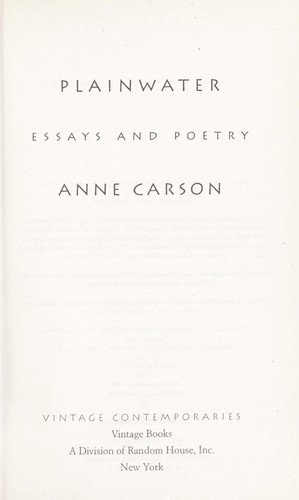
Cover of Plainwater

Plainwater

Anne Carson

5 ideas

  1. Walking the Camino With 'My Cid'

    In 'Kinds of Water' the narrator walks the pilgrim road across northern Spain to Santiago de Compostela with a companion she calls only 'My Cid.' The account is a sequence of short diary entries, each titled by the town reached that day, so the essay moves forward by stops rather than by argument. The physical route, the uneasy intimacy between the two walkers, and her reading about pilgrimage run side by side without being resolved into one meaning.

  2. A Father Whose Language Comes Apart

    The introduction to 'The Anthropology of Water' describes the narrator's father sinking into dementia and speaking in broken, private phrases, alongside a brother who has vanished and makes only rare contact. She listens to her father's speech as if it were a foreign language she is trying to translate, rather than as mere failure. The grief of both losses is presented as the pressure that sends her out on the road.

  3. The Pilgrim Is a Walking Question

    Pilgrimage is framed as carrying an unanswerable question on foot rather than traveling toward a known destination or cure. Motion stands in for resolution: the walking, the daily arrivals and the attention the road demands give the question a shape that can be lived with, without ever answering it. Seen this way, any purposeful journey reveals what the traveler cannot solve at home.

  4. Interviewing the Dead Poet

    In the Mimnermos section, Carson follows her translations of the archaic Greek poet's fragments with an essay and then invented interviews with Mimnermos himself. Scholarship shifts into fiction to reach what the surviving text cannot say directly. The gaps in the record become a space for imaginative dialogue with the dead author, not something to be patched over with footnotes.

  5. Fragmentary Form Tells the Truth About Loss

    The book repeatedly chooses broken or compressed forms: Greek fragments, one-paragraph 'Short Talks', and journal entries cut off at each town. It argues through practice that these forms are more honest than continuous argument for material that is itself incomplete, such as memory, desire, a failing mind or a half-lost ancient poem. The hybrid essay carries the gaps openly instead of smoothing them into a false whole.

Save and mark ideas in the app