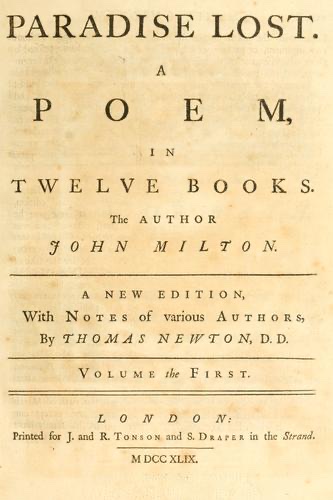
Cover of Paradise Lost

Paradise Lost

John Milton

4 ideas

  1. Satan's temptation of Eve at the Tree

    Satan, disguised as a serpent, persuades Eve to eat the forbidden fruit by claiming it gave him, a mere beast, the power of reason and speech, so it would lift her to godhood. She eats alone after insisting on working apart from Adam, and Adam then eats knowingly, choosing to share her fate rather than lose her. The pair are expelled from Eden, leaving 'hand in hand, with wandering steps and slow.'

  2. The mind is its own place

    Satan declares that 'the mind is its own place, and in itself can make a Heaven of Hell, a Hell of Heaven.' Changing your surroundings or your interpretation does not escape a torment that comes from your own settled will.

  3. Free will requires the real possibility of falling

    God made angels and humans 'sufficient to have stood, though free to fall,' because obedience that cannot fail is only necessity and has no moral value. Foreknowing the Fall does not cause it; responsibility for the choice lies with the chooser. This is the poem's core argument for justifying God's permission of evil.

  4. Wounded pride recast as principled rebellion

    Satan's revolt starts when the Son is exalted above him. He retells that injured sense of merit as a fight for liberty against tyranny. His speeches are grand enough that readers are drawn to him, and the poem uses that pull to show how resentment can pass itself off as heroic independence, ending in the inversion 'Evil, be thou my Good.'

Save and mark ideas in the app