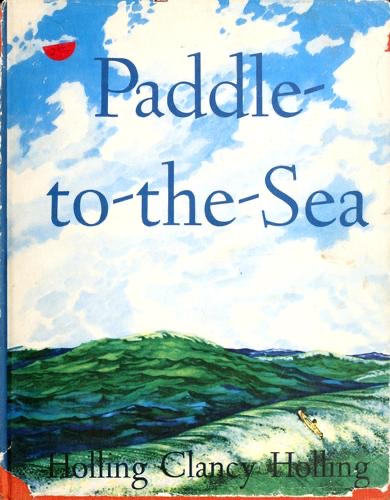
Cover of Paddle-to-the-Sea

Paddle-to-the-Sea

Holling C. Holling

4 ideas

  1. Carved canoe journeys Nipigon to Atlantic

    A boy near Lake Nipigon carves a small canoe with a seated paddler, weights it with lead so it rights itself, and carves on it: 'Please put me back in water. I am Paddle-to-the-Sea.' He sets it on a snowbank to wait for the spring melt, and over several years it drifts down streams into Lake Superior and on through the Great Lakes, over Niagara, and down the St. Lawrence to the Atlantic. Along the way strangers repeatedly find it and put it back in the water.

  2. The watershed as one connected route

    Following a single floating object shows that a trickle of snowmelt in northern Ontario and the Atlantic Ocean are one continuous system. Streams, lakes, rapids, canal locks and falls stop looking like separate places and become stages of one downhill flow. Local water always belongs to a larger drainage that connects distant regions.

  3. Traveling object as a guided tour

    A passive object moving through a landscape lets each chapter stop at one new setting, such as a sawmill, ore docks, shipping locks, a fishery or a waterfall. At each stop, marginal diagrams explain how that place works, including its geology, industry and wildlife. The journey supplies the narrative drive, and the stops supply the lessons, so natural history and economic geography become part of the story.

  4. An inscribed request enlists strangers' help

    The canoe cannot steer, so its journey succeeds only because each finder reads the carved plea and chooses to pass it on. A plain request attached to the object itself turns unconnected people into a relay chain across a continent. Designing for the journey means combining that request with physical robustness, such as the self-righting lead weight, and with timing that uses natural forces like the spring thaw.

Save and mark ideas in the app