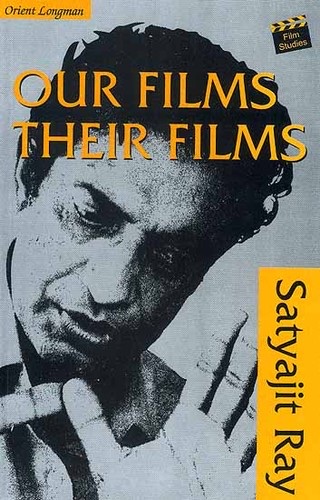
Cover of Our Films, Their Films

Our Films, Their Films

Satyajit Ray

5 ideas

  1. Indian cinema must draw from Indian life

    Ray argues that Indian films fail because their makers have not grasped cinema as a distinct medium. They copy the surface gloss of Hollywood without its underlying craft. His remedy is to treat life itself as cinema's raw material: an Indian filmmaker should look at the landscapes, gestures, rhythms and speech of Indian life, and not stitch together borrowed formulas of songs, stars and melodrama.

  2. Pather Panchali made against all odds

    While working for an advertising agency in London in 1950, Ray saw De Sica's Bicycle Thieves. It convinced him that a film could be made with non-professional actors and real locations. Back in Calcutta he shot Pather Panchali in fits and starts over several years, halting whenever money ran out, until the West Bengal government funded its completion; the film then won international acclaim beginning in 1955-56.

  3. Classical Hollywood craft works by being invisible

    Ray admired American masters such as John Ford for their economy and clarity. In their films every shot moves the story forward and the technique never calls attention to itself. For Ray, the lesson from Hollywood lay in this disciplined, self-effacing storytelling rather than in its glamour or production values.

  4. Meaning carried by the telling detail

    Ray treats the precisely observed physical detail as cinema's chief expressive tool: a gesture, an object, a sound, a small piece of business. These can reveal character and emotion more truthfully than dialogue or explanation. The filmmaker's job is to notice the specific, revealing particular and let the audience read it.

  5. Communication as the filmmaker's obligation

    Ray criticizes the self-consciously experimental films of India's emerging new wave. He argues that obscurity and borrowed avant-garde mannerisms are no substitute for clear communication with an audience. Working in a country with a large, varied audience, he holds that a serious filmmaker must earn complexity through lucidity rather than use difficulty as a mark of seriousness.

Save and mark ideas in the app