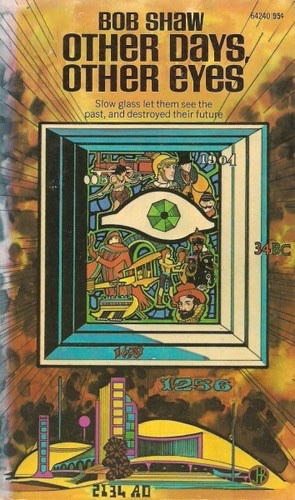
Cover of Other Days, Other Eyes

Other Days, Other Eyes

Bob Shaw

4 ideas

  1. Slow glass as delayed-light storage medium

    Slow glass is a material whose thickness sets how long light takes to pass through it, so a pane stores a scene for years and later replays it on the far side. This turns glass into a passive recorder: anything that happens in front of it becomes a retrievable record without a camera, power source, or anyone deciding to record.

  2. The farmhouse window showing a dead family

    A couple driving in the Scottish highlands stops at a roadside seller of slow-glass 'scenedows' and sees, through his cottage window, a woman and child moving about the house. They learn the man's wife and child were killed years earlier, and he lives alone with the glass that still shows them as they were. He has chosen to live with a replaying image of the past instead of letting it end.

  3. Time-shifted observation destroys privacy more thoroughly

    When cheap slow-glass fragments can be scattered anywhere and read years later, surveillance is decoupled from the moment it happens, so no one can check whether they are being watched now. Because any past act may later be recovered, people have to behave as if they are always observed, and the record is harvested long after the watched have forgotten it.

  4. Trace an invention's drift toward control

    Follow a technology as its cost falls and see its dominant use shift from luxury and sentiment (scenic windows) to forensic evidence and then to state and commercial surveillance. The same physical property that sold as beauty becomes a tool of coercion, and the inventor has no say over which use prevails once the material is cheap and widespread.

Save and mark ideas in the app