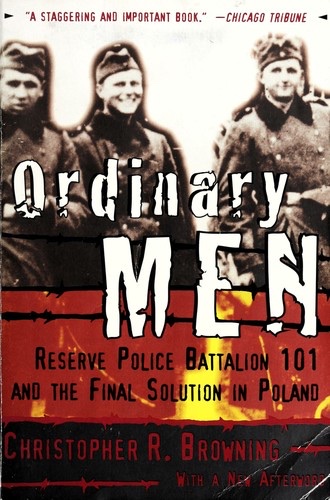
Cover of Ordinary Men

Ordinary Men

Christopher Browning

4 ideas

  1. Major Trapp's offer at Józefów

    On 13 July 1942, Major Wilhelm Trapp told the roughly 500 men of Reserve Police Battalion 101, middle-aged Hamburg reservists, that they were to shoot the Jewish women, children and elderly of Józefów, Poland. He offered to excuse any older man who did not feel up to it. About a dozen stepped out and were not punished, yet most of the rest shot roughly 1,500 people that day; the postwar interrogations Browning drew on found no case of a policeman gravely punished for refusing to kill.

  2. Conformity, not ideology, drove most killers

    Most of the policemen shot not because they hated Jews or feared punishment but because stepping out meant breaking ranks and leaving the 'dirty work' to comrades. Refusal was framed as weakness or as moral reproach of the group, so the pull of the unit and the fear of isolation outweighed individual revulsion.

  3. Habituation and division of killing labor

    The first face-to-face massacre caused widespread shock, vomiting and drinking, yet within months the same men carried out much larger killings with little visible distress. Two things made this possible: repetition blunted revulsion, and the work was split up so that deportations to Treblinka and 'Hiwi' auxiliaries took over the most intimate killing. Each man's task shrank and felt more routine.

  4. Three-way sorting of perpetrator responses

    Over time the battalion split into three groups. A core of eager killers volunteered for shooting squads and 'Jew hunts'. A large middle group did what they were ordered to do but did not seek out killing. A minority of 10 to 20 percent avoided or evaded shooting, often without principled protest. This spread among men with similar backgrounds shows that situational pressure shapes behavior powerfully but does not decide it, which keeps individual choice and responsibility in view.

Save and mark ideas in the app