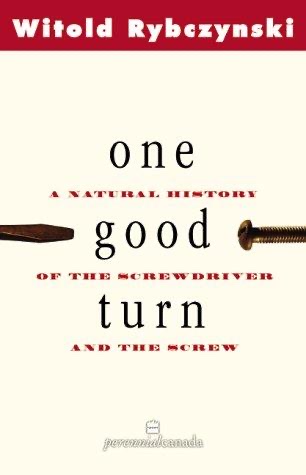
Cover of One Good Turn

One Good Turn

Witold Rybczynski

4 ideas

  1. The screwdriver as the millennium's only new hand tool

    Nearly every basic hand tool, including the saw, hammer, chisel, plane and drill, already existed in developed form by Roman times. That is the basis for calling it the best tool of the millennium: it is the period's genuinely original contribution rather than a refinement of an ancient design.

  2. Precision screws require precision screws to make

    Accurate screw threads are produced most reliably on a lathe guided by an accurate lead screw, so each generation of precision depends on the one before it. Hand-filed early screws were irregular and not interchangeable. Makers such as Jesse Ramsden and Henry Maudslay broke the loop in the late eighteenth century by building screw-cutting lathes that let each new, better screw be used to cut a still more exact one.

  3. Weapons and armour as the screw's cradle

    The screw and screwdriver did not first appear in carpentry. They show up in late-medieval armour and in the firing mechanisms of matchlock and wheel-lock guns, where small parts needed secure fastening that could still be taken apart. Tracing a common tool back to high-value military craft shows how precision fastening was developed where its cost could be justified, before it moved into everyday building.

  4. Robertson's square drive versus Phillips' cross

    In 1908 the Canadian P. L. Robertson patented a square-socket screw that grips the driver and resists slipping, and Ford used it in Canadian car production. Robertson refused to give up control of his patent under licence, so the design never spread widely in the United States.

Save and mark ideas in the app