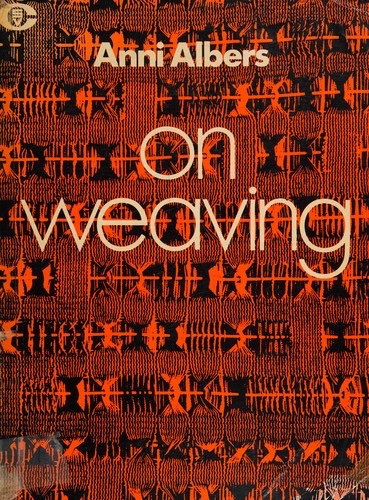
Cover of On Weaving

On Weaving

Anni Albers

6 ideas

  1. Weaving is structure before it is surface

    A textile's character comes first from how warp and weft interlace, not from the color or pattern applied on top. Because the construction produces the fabric's strength, drape, texture and much of its visual effect, design should start with the weave structure and treat decoration as secondary.

  2. The loom as a constraining grid

    The loom sets a rectilinear system: warp threads run fixed lengthwise, and weft threads cross them at right angles. Every weave is a way of working inside that orthogonal grid. The limitation is productive, because it pushes the weaver toward structural invention rather than free-form imagery.

  3. Three fundamental weaves as generative base

    Plain weave, twill and satin are the elementary binding systems, and every more complex weave derives from varying or combining them. A plain weave interlaces in simple alternation. A twill steps its interlacing point to make a diagonal. A satin spaces its interlacings widely to leave long floats and a smooth face. Learning these three gives the weaver a grammar for building any fabric.

  4. Draft notation as abstract representation

    Weave drafts are grid diagrams that record which threads are raised and lowered. They encode a fabric as a binary pattern on paper, separate from any material. This notation lets a weaver think about structure abstractly, predict the result before weaving, and communicate designs precisely, which shows the kinship between weaving and systems of coding.

  5. Industrial life atrophies tactile sensibility

    Modern people rely mostly on sight and meet materials already processed and finished, so the sense of touch goes largely unused. Working directly with raw materials and the tactile qualities of surfaces, such as roughness, smoothness, pliability and resistance, restores a mode of perception that visual culture has neglected.

  6. Ancient Peruvian weavers as supreme masters

    Ancient Andean cultures had no written language, yet they produced textiles of extraordinary technical range and invention, using nearly every known weaving technique on simple backstrap looms. Their fabrics carried meaning and record-keeping in the absence of writing, which shows that a craft practiced with simple tools can reach the highest level of intellectual and artistic achievement.

Save and mark ideas in the app