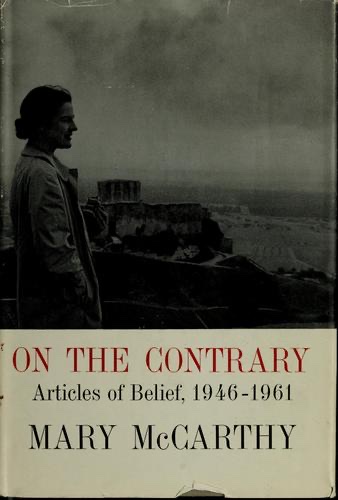
Cover of On the Contrary

On the Contrary

Mary McCarthy

5 ideas

  1. Accidentally signing onto the Trotsky Defense Committee

    At a 1936 New York literary party, McCarthy was asked casually whether Trotsky deserved a hearing on the Moscow Trials charges, and she said yes, anyone accused has a right to be heard. Days later she found her name on the letterhead of the American Committee for the Defense of Leon Trotsky, which she had never formally joined. When Stalinist acquaintances phoned and pressed her to withdraw, their coercion made her refuse, and she became an anti-Stalinist without having read Trotsky or examined the evidence.

  2. Convictions are chosen by accident, hardened by pressure

    Political allegiance is often fixed by chance social moments, such as an offhand remark, a party, or who happens to ask, rather than by reasoned study. Once taken, the position is locked in less by argument than by the crude pressure of opponents to recant, because giving way to intimidation feels like a moral failure. Honest self-accounting means admitting this contingency instead of retroactively narrating a principled journey.

  3. Pressure to recant reveals the pressurer

    How a movement treats a waverer, whether by argument or by phone calls, social threats, and demands for loyalty, is itself evidence about the movement's nature. McCarthy judged the Stalinists less by their doctrine than by their methods of enforcing conformity among friends. Watching the enforcement mechanism can tell you more than weighing the stated case.

  4. Fictional details are facts, not symbols

    In 'Settling the Colonel's Hash,' McCarthy answers readers who treated the corned-beef hash in her story 'Artists in Uniform' as a hidden symbol: the colonel ordered hash because that is what happened. Realist fiction draws its authority from accurate, contingent fact. Reading every detail as a coded symbol destroys the story's truth-telling function and swaps real experience for a decoding game.

  5. American materialism is actually indifference to things

    In 'America the Beautiful,' McCarthy argues that Americans are not materialists in the European sense of loving and preserving particular objects. They treat possessions as abstract, interchangeable and disposable, valuing the idea of having over the thing itself. The consumer culture critics call materialistic is really a detachment from the material world.

Save and mark ideas in the app