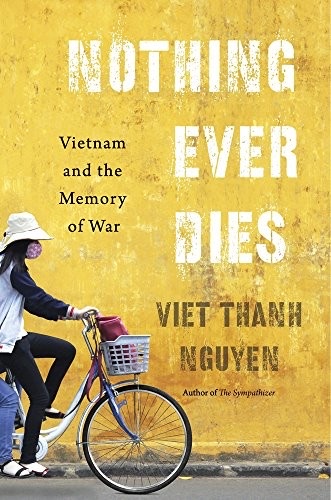
Cover of Nothing Ever Dies

Nothing Ever Dies

Viet Thanh Nguyen

6 ideas

  1. Every war is fought twice

    A war's second battle is fought in memory, where the stakes are identity, legitimacy and who counts as human rather than territory. Victors and losers keep fighting for decades through monuments, films, museums and textbooks, so the conflict is never finished when the shooting stops.

  2. Ethics of remembering one's own

    Nguyen distinguishes an ethics that remembers only one's own dead, an ethics that also remembers others, and a fuller ethics that recognises both one's own and others' humanity and inhumanity. The third stance is the hardest because it asks a group to admit that it too killed, tortured or betrayed, and not only that it suffered.

  3. Industries of memory

    Memory is manufactured and distributed like any commodity, and powerful industries such as Hollywood, state museums and publishing decide which versions of the past circulate globally. Remembering is therefore a matter of economic and military power. A superpower can make the world see a war it lost through its own soldiers' trauma.

  4. Just memory versus just remembering

    A just memory refuses to be shallow remembrance that honours the dead while leaving power relations untouched. It asks how memory is produced, who is excluded, and whether the act of remembering actually redistributes recognition and responsibility.

  5. Humanizing narratives can still erase others

    American war stories that stress the humanity and anguish of American soldiers often reduce Vietnamese, Cambodians and Laotians to silent backdrops or victims. Sympathy centred on one side's inner life reproduces the war's hierarchy of who matters, even when the work is explicitly anti-war.

  6. Asymmetric memorials in Washington and Vietnam

    The Vietnam Veterans Memorial lists about 58,000 American names, while the millions of Vietnamese dead would require a wall many kilometres long. Vietnam's state memorials likewise honour revolutionary martyrs and neglect southern soldiers, while Cambodian and Laotian victims barely register in either nation. Each monument shows how states build memory by choosing whose dead count.

Save and mark ideas in the app