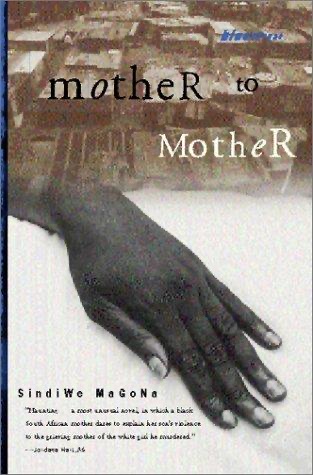
Cover of Mother to Mother

Mother to Mother

Sindiwe Magona

4 ideas

  1. Amy Biehl's killing in Guguletu, 1993

    On 25 August 1993, Amy Biehl, a white American Fulbright scholar working on voter education before South Africa's first democratic election, was driving Black colleagues home to Guguletu near Cape Town. Youths leaving a political gathering, some chanting "One settler, one bullet," pulled her from the car and stoned and stabbed her to death. Several of the young men convicted were later granted amnesty by the Truth and Reconciliation Commission, with the support of Biehl's parents. The novel is narrated by the fictional mother of one of the killers.

  2. The killer was made before the killing

    The novel argues that one youth's single act of murder is the end point of a long causal chain: forced removals, Bantu Education, fathers absent because of migrant labour, and a political climate that made white skin mean enemy. The mother does not excuse her son. She holds him responsible and also insists that the society which shaped him shares the guilt. Individual culpability and structural causation are presented as true together, not as alternatives.

  3. The perpetrator's mother as a second mourner

    Addressing the letter mother to mother reframes the killing as a loss on both sides. One woman has lost her daughter to death. The other has lost her son to the act of killing, and possibly lost him long before it. The grief of a perpetrator's family is normally invisible or forbidden, and here it becomes a legitimate way to see the crime. That shared maternal position is offered as the only ground from which one woman can speak to the other across race.

  4. Nongqawuse's prophecy as self-destructive despair

    The novel sets the Xhosa cattle-killing of 1856–57 inside the family's inherited stories. In that episode, a prophecy that the whites would be driven out led people to destroy their own cattle and crops, and mass starvation followed. The novel uses it as a template for the 1990s township violence. Under prolonged colonial humiliation, a people's rage and hope for liberation can turn into acts that destroy their own community and future as much as the oppressor.

Save and mark ideas in the app