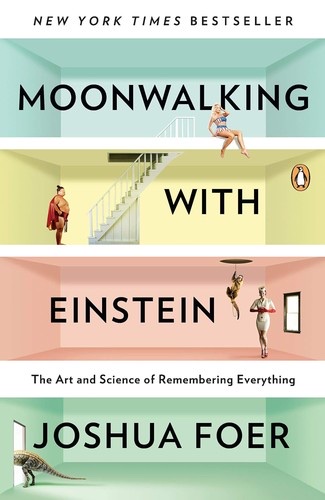
Cover of Moonwalking with Einstein

Moonwalking with Einstein

Joshua Foer

4 ideas

  1. Journalist becomes US memory champion

    Joshua Foer went to the 2005 US Memory Championship to write about it. Competitors there, including Ed Cooke, told him they had average memories and had trained with ancient techniques. After a year of daily practice with Cooke's coaching, Foer won the 2006 championship and set a US record by memorizing a shuffled deck of cards in about 1 minute 40 seconds, which is evidence that elite memory feats can be trained rather than inborn.

  2. Memory palace: images placed along routes

    The method of loci turns abstract items into vivid, bizarre, often lewd or funny images and places them at fixed locations along a route through a familiar building. Recall means walking the route in your mind again. It works because humans are much better at remembering pictures and space than lists or numbers, so it recodes weak information into the forms memory handles best.

  3. The OK plateau in skill acquisition

    Once a skill becomes automatic, conscious attention withdraws and improvement stops at a 'good enough' level. To break the plateau you must deliberately push past your comfort zone, measure your failures, and study where you break down, as when Foer used a metronome to force himself to memorize cards faster than was comfortable. Effortless repetition keeps you where you are; only effortful and monitored practice produces gains.

  4. Expertise is memory organized into chunks

    Experts do not have better raw memories. They perceive their domain in large, meaningful chunks built from stored experience, as with chess masters who can reconstruct real game positions at a glance but do no better than novices on randomly placed pieces. Because of this, memorized knowledge is the substrate of skilled judgment and creativity, not a rival to them, and externalizing all memory to books and devices weakens that substrate.

Save and mark ideas in the app