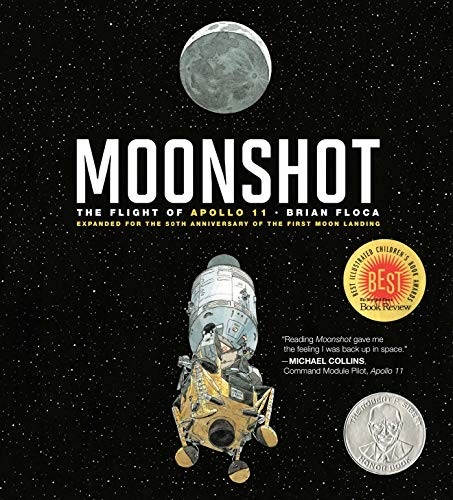
Cover of Moonshot

Moonshot

Brian Floca

4 ideas

  1. Eagle lands with seconds of fuel

    During Apollo 11's descent on July 20, 1969, the lunar module Eagle's computer threw alarms and its automatic path headed for a crater strewn with boulders. Neil Armstrong took semi-manual control and skimmed past the rocks, with Buzz Aldrin calling out altitude and speed, while fuel ran so low that Mission Control began counting down the seconds remaining. They touched down in the Sea of Tranquility, and Armstrong radioed, 'Houston, Tranquility Base here. The Eagle has landed.'

  2. Epic achievement as a chain of routines

    The moon landing is shown not as one heroic leap but as a sequence of ordinary procedural acts: suiting up, strapping in, throwing switches, eating from pouches, sleeping in a cramped cabin. Rendering the mundane steps makes an otherwise incomprehensible feat legible. The grandeur comes from seeing how many small, correctly executed actions it took.

  3. The essential crew member who stays behind

    While Armstrong and Aldrin descend to the surface, Michael Collins circles the Moon alone in the command module Columbia. He passes out of radio contact each time he goes around the far side, and he is the crew's only way home. The mission's most celebrated moment depends on a role designed to be invisible and never to touch the goal itself.

  4. Technical accuracy carries the emotional weight

    The rockets, cockpit panels, and procedures are drawn with near-documentary precision, even for a child audience. The spare, lyrical main text supplies the feeling, and the dense, accurate visual detail and diagrams supply the credibility. Getting the particulars right is what makes the wonder earned rather than asserted, and it treats young readers as capable of handling real complexity.

Save and mark ideas in the app