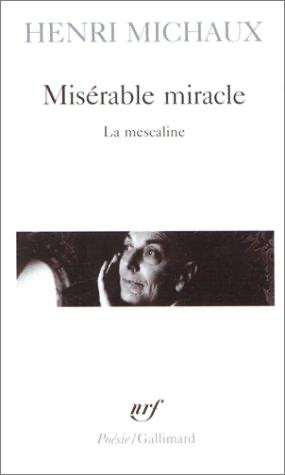
Cover of Miserable Miracle

Miserable Miracle

Henri Michaux

3 ideas

  1. Acceleration as mescaline's core effect

    Michaux identifies speed, not visionary content, as the drug's primary action: images, thoughts and impulses arrive in torrents so fast that the self cannot hold, select or finish any of them. The visions feel trivial and garish, like cheap fairground imagery, because the mind is flooded faster than it can give meaning to what it sees, hence a 'miserable' miracle.

  2. Watching the mind from inside its collapse

    Michaux treats intoxication as an instrument for observing ordinary mental operations: when attention, will and continuity of the 'I' are disrupted, one can see that they were active achievements all along rather than givens. The breakdown shows that sober selfhood depends on the mind's normal slowness and its ability to filter and hold onto things.

  3. Drug experience defeats language and representation

    Michaux argues that the mescaline state cannot be faithfully rendered in sentences, because language is linear, sequential and slow while the experience is simultaneous, repetitive and vibratory. He therefore turns to fragmented prose, marginal notes and rhythmic drawings as partial seismographs rather than descriptions, accepting that any record falsifies the experience by ordering it.

Save and mark ideas in the app