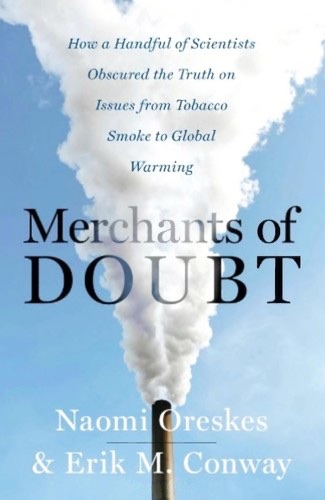
Cover of Merchants of Doubt

Merchants of Doubt

Naomi Oreskes and Erik Conway

6 ideas

  1. Doubt as the manufactured product

    The tobacco industry's 1969 Brown & Williamson memo stated that 'doubt is our product,' because doubt competes with the body of fact in the public mind. The strategy does not need to disprove the science. It only needs to create the impression that the question is still open. Public uncertainty is enough to stall regulation indefinitely.

  2. Same physicists, from tobacco to climate

    Frederick Seitz, Fred Singer, Robert Jastrow and William Nierenberg were elite Cold War physicists, several of them tied to the George C. Marshall Institute. Across decades they lent their credentials to contesting evidence on smoking, secondhand smoke, acid rain, ozone depletion and global warming. None of them had research expertise in those fields. Their authority came from prestige in unrelated physics, which the press and politicians treated as general scientific credibility.

  3. Free-market ideology, not science, drove denial

    These scientists were motivated by Cold War anticommunism and free-market fundamentalism. They saw environmental regulation as a slippery slope toward socialism. Because accepting the science would justify government intervention, they attacked the science instead of arguing openly about policy values.

  4. Journalistic balance as a vector for distortion

    The media norm of presenting 'both sides' gives a handful of contrarians equal airtime with an overwhelming consensus. Audiences then perceive a live scientific debate where none exists. The fairness convention turns into a mechanism that amplifies manufactured doubt.

  5. The recurring denial playbook

    The same sequence repeats across issues. First, insist more research is needed before acting. Second, fund friendly scientists and think tanks to produce contrary reports. Third, attack the integrity of individual researchers and of peer-reviewed bodies such as the IPCC. Fourth, frame regulation as costly and as a threat to liberty. Each step delays action without ever having to win the scientific argument.

  6. Scientific uncertainty is exploited against consensus

    Science always carries residual uncertainty, and scientists state it candidly. Doubt-mongers exploit that honesty, recasting normal caveats as evidence that nothing is known. Demanding certainty before policy sets an impossible standard, which guarantees inaction.

Save and mark ideas in the app