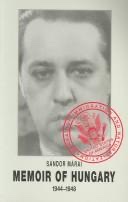
Cover of Memoir of Hungary, 1944–1948

Memoir of Hungary, 1944–1948

Sándor Márai

6 ideas

  1. Returning to the Destroyed Budapest Library

    Márai sat out the siege of Budapest outside the capital at Leányfalu, where Red Army soldiers moved through the house and requisitioned what they wanted, including watches. When he returned to Budapest he found his apartment on Mikó utca in ruins and his library of several thousand books destroyed. He treats the loss as the physical end of the literate, private bourgeois life the books represented, not just a loss of property.

  2. Liberators Cannot Give What They Lack

    The Soviet soldiers ended the German occupation and the Arrow Cross terror, but Márai argues they could not bring freedom to Hungary because they did not have it themselves. An army of people living without liberty can remove one oppressor, but it can only set up the kind of order it knows at home. Liberation from something is therefore not the same as liberation into something.

  3. Totalitarianism Demands Assent, Not Mere Silence

    As the communists consolidated power between 1945 and 1948, Márai found that withdrawing into silence was no refuge, because the regime read a writer's silence as a statement of opposition. The new system did not simply want him to stop saying the wrong things. It wanted him to say the right ones. Once neutrality is treated as dissent, exile becomes the only way to stay honest, and that is why he left in 1948.

  4. Bourgeoisie as Culture, Not Economic Class

    Márai sees the bourgeoisie as a way of life rather than an income bracket. It is built on privacy, personal responsibility, cultivated taste, reading, and continuity between generations. From this angle, the communist takeover aimed at more than seizing property: it set out to make that inner, individual form of life impossible. Once the way of life is gone, redistributing its possessions cannot bring it back.

  5. Losing the freedom to stay silent

    Under the consolidating communist regime, censorship of speech was not the decisive loss. Writers and citizens were compelled to publicly affirm the new order, so even withdrawal and silence became readable as dissent. Márai treats the end of permitted silence as the point at which an independent writer can no longer remain, and he names it as his reason for leaving in 1948.

  6. Revolution as the dismantling of the citizen

    Márai reads the communist takeover chiefly as the destruction of the 'polgár', the educated, property-holding, self-governing citizen class and its habits of individual judgment. He does not frame it mainly as a change of government. Seen this way, the gradual 1945–48 seizures of institutions, property and parties amount to a single project of eliminating the social type able to live independently of the state.

Save and mark ideas in the app