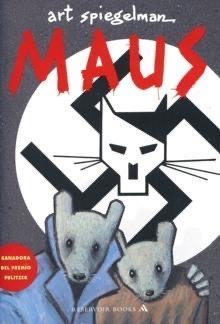
Cover of Maus

Maus

Art Spiegelman

4 ideas

  1. Vladek's survival through practical resourcefulness

    Vladek Spiegelman, a Polish Jewish textile merchant from Sosnowiec, survived the ghettos, hiding, and Auschwitz by trading, bribing, and making himself useful: he posed as a skilled tinsmith and shoemaker and tutored a kapo in English to get extra food and protection. His wife Anja also survived, but their first son Richieu died in hiding. In later life in Rego Park, Vladek hoarded compulsively, was bitterly miserly, and was openly racist toward a Black hitchhiker. The same traits that had kept him alive made him a difficult man to live with, which shows that survival skills persist after the danger is gone and that surviving did not make him morally better.

  2. Animal masks expose racial categorization

    Drawing Jews as mice, Germans as cats, and Poles as pigs takes the Nazis' own logic of fixed racial species and pushes it into the open, so the reader sees it as a constructed category. The book then undermines its own scheme: characters wear masks of other animals to pass, and Art struggles over how to draw his French wife, who converted to Judaism. The visual metaphor both carries the history and shows how arbitrary and dangerous it is to sort people into kinds.

  3. Second-generation guilt and the ghost sibling

    The child of survivors inherits a catastrophe he did not live through. He feels guilty for having had an easier life and cannot measure up to the parents' suffering. Art feels he is competing with Richieu, the brother who died before he was born and exists only as an idealized photograph. The inherited trauma shows up as an unresolvable debt: the son can neither share the experience nor escape its weight.

  4. Testimony is shaped by its recording

    A survivor's history reaches us through a strained relationship, not as raw fact. Vladek's account is filtered through his selective memory, and Art's tape recorder records it. Art keeps his framing choices visible, including his own impatience, his arguments with his father, and his guilt over profiting from the story. By showing Vladek's burning of Anja's diaries and the gaps it leaves, the work argues that honest representation of atrocity means showing what cannot be recovered.

Save and mark ideas in the app