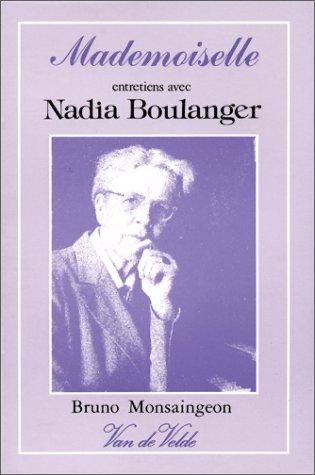
Cover of Mademoiselle

Mademoiselle

Nadia Boulanger with Bruno Monsaingeon

4 ideas

  1. Piazzolla told to stop hiding tango

    In 1954 Astor Piazzolla brought Boulanger the symphonic and chamber scores he considered his serious work, and hid that he played tango in Buenos Aires nightclubs. She judged the scores competent but impersonal, pressed him until he played one of his own tangos, and told him that this was the real Piazzolla and he must never abandon it. He returned to Argentina and built nuevo tango from the idiom he had been ashamed of.

  2. Rigid technique is the precondition of freedom

    Boulanger drilled students in counterpoint, figured bass, sight-singing and Bach chorales until these skills became automatic. She held that freedom is not the absence of rules. It is what becomes possible once technical execution needs no conscious effort, which leaves the mind free for the musical idea. A student who has not mastered the rules is not free to break them, only unable to follow them.

  3. Attention as the root musical faculty

    For Boulanger, the decisive difference between musicians is not talent but the quality of attention: whether they hear every note, every voice and every relationship, or only a general impression. She treated inattention as the real source of mediocrity. She also treated attention as trainable, through exercises that force the ear and mind to account for everything that happens rather than skim.

  4. Standardize the craft, never the style

    Boulanger imposed the same exacting technical training on every student. She refused to impose an aesthetic, which is why pupils as different as Copland, Glass and Piazzolla came out of the same classroom sounding nothing alike. Seen this way, a teacher's job is to give a common discipline and then find each student's own voice, not to reproduce the teacher's taste.

Save and mark ideas in the app