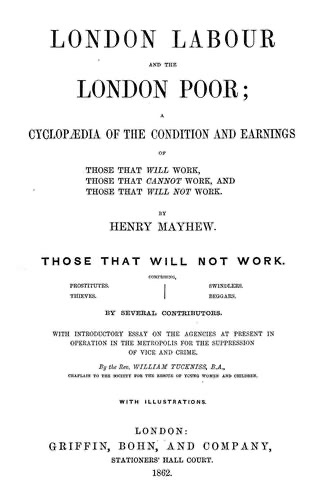
Cover of London Labour and the London Poor

London Labour and the London Poor

Henry Mayhew

4 ideas

  1. Underpay breeds overwork breeds surplus labour

    When piece rates fall, workers work longer hours or bring their families into the trade to keep their income steady. This raises the supply of labour in that trade, which pushes rates down further and starts the cycle again. Low wages therefore create their own glut of labour instead of correcting it.

  2. Irregular income, not vice, drives improvidence

    Dock labourers, costermongers and other casual workers swing between feast and famine, so the habits outsiders call vice follow from the structure of their earnings. Drinking, gambling and failure to save make sense when income is unpredictable and no single week's saving can cover the bad weeks. To change the behaviour, change the regularity of employment, not the moral character of the worker.

  3. The eight-year-old watercress seller

    Mayhew interviews a girl of eight who sells watercress in winter streets. Her testimony shows that economic necessity erased childhood for the street poor, and it shows this more forcefully than any statistic.

  4. The finders' refuse economy

    A whole layer of London made its living by recovering value from waste. Pure-finders collected dog dung for tanneries, mudlarks searched the Thames foreshore for coal and metal, sewer-hunters scavenged the drains, and bone-grubbers sold scraps on. Each of these trades supplied some industry with raw material. The city's refuse worked as a resource market, and the poorest workers served as its collection system.

Save and mark ideas in the app