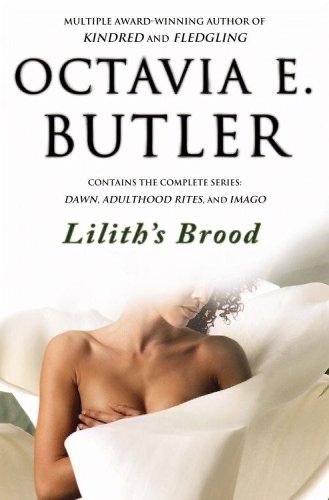
Cover of Lilith's Brood

Lilith's Brood

4 ideas

Buy on Amazon

In an undated future after nuclear war, Lilith Iyapo wakes among the humans saved by the alien Oankali. Their rescue comes with a demand: the two species must interbreed. Across this science fiction trilogy, Butler makes survival inseparable from questions of consent, bodily autonomy and who gets to choose humanity’s future.

  1. Intelligence Yoked to Hierarchy Is Self-Destructive

    The Oankali diagnose humanity's fatal flaw as a genetic contradiction: a newer trait, intelligence, placed in the service of an older one, hierarchical behaviour, rather than governing it. Because intelligence amplifies the drive to dominate instead of restraining it, a species with both traits will eventually build tools powerful enough to destroy itself, as humans did in the nuclear war.

  2. Lilith Iyapo Awakened to Lead Humanity

    Lilith Iyapo, a Black American woman who survived nuclear war, wakes 250 years later aboard a living Oankali ship. The Oankali choose her to awaken and train other human captives for resettlement on a restored Earth. The humans she prepares treat her as a traitor and collaborator, and she is later impregnated through an ooloi without her explicit agreement. Her mixed child, Akin, becomes the first human-born male construct.

  3. The Trade: Survival Through Genetic Merger

    The Oankali survive by acquiring genes from other species and merging with them, so both parties are transformed into a new hybrid species and neither continues in its original form. Human survivors are offered this merger or sterility, which means rescue and assimilation cannot be separated.

  4. Consent Judged by the Body Over Words

    The ooloi can read human bodies chemically, and they claim a person's physiology reveals what that person truly wants even when the person refuses in words. They use this to justify sexual and reproductive acts the human verbally resists. The lens raises a hard question: once a powerful party claims to know your desires better than you can state them, consent turns into their interpretation of you rather than your own choice.

Save ideas and give them a thumbs up or down in the app