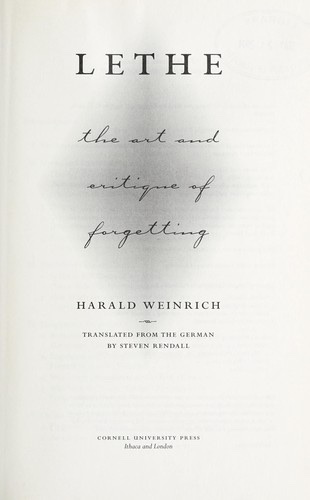
Cover of Lethe: The Art and Critique of Forgetting

Lethe: The Art and Critique of Forgetting

Harald Weinrich

6 ideas

  1. Themistocles asks to learn forgetting instead

    Offered Simonides' celebrated art of memory, the Athenian statesman Themistocles reportedly replied that he would rather learn an art of forgetting, since he remembered things he did not wish to and could not forget what he wanted to. The anecdote reframes the problem of mind as a surplus of unwanted retention rather than a deficit of recall.

  2. Deliberate forgetting defeats itself by rehearsal

    An art of forgetting cannot be built like an art of memory, because any technique that targets a memory for deletion must first call it up, which strengthens it. Kant illustrates the paradox: after dismissing his longtime servant Lampe, he wrote a note to himself that 'the name Lampe must now be completely forgotten,' a reminder that preserved the very name it meant to erase.

  3. Truth as un-forgetting: aletheia

    The Greek word for truth, a-letheia, is built from the negation of lethe, forgetting, so truth is conceived as what has been drawn out of oblivion. On this view forgetting is the default condition of the mind, and knowledge is an effortful act of recovery against it.

  4. Active forgetting as a condition of life

    Nietzsche argues that an excess of historical memory paralyzes action, and that a person or culture needs the capacity to forget in order to act, heal, and create. Forgetting in this sense is not a failure of memory but a positive, selective power that clears space for the present.

  5. Weak memory as a source of judgment

    Montaigne presents his notoriously poor memory as an advantage: because he cannot store and recite others' opinions, he is forced to think through questions with his own judgment. Seen this way, forgetting filters borrowed learning and converts accumulated erudition into independent reasoning.

  6. After Auschwitz, forgetting becomes a moral wrong

    Survivor-witnesses such as Primo Levi and Jean Améry insist that the crimes of the camps must not be forgotten, which transforms remembrance from a mental faculty into an ethical obligation. The same forgetting that is praised elsewhere as healing or liberating is condemned here as complicity with the perpetrators, so the value of forgetting depends on what is being forgotten and whom it serves.

Save and mark ideas in the app