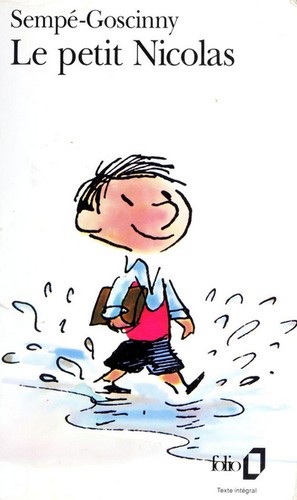
Cover of Le Petit Nicolas

Le Petit Nicolas

René Goscinny and Jean-Jacques Sempé

4 ideas

  1. How the supervisor became 'Le Bouillon'

    The school's playground supervisor opens every reprimand with 'Regardez-moi bien dans les yeux' ('Look me right in the eyes'). The older boys nicknamed him 'Le Bouillon' because a bouillon (broth) has 'yeux', the name for the fat globules floating on its surface.

  2. Child narrator makes readers see what he misses

    Nicolas reports adult behaviour accurately but without understanding it: his father's sulks, his parents' coded quarrels, a teacher's exhaustion. The reader supplies the meaning the narrator cannot. The comedy, and the tenderness, come from the gap between what is told and what is understood, and that gap turns the adult reader into a silent accomplice of the grown-ups being described.

  3. One-trait ensemble as a comic recombination engine

    Each friend is fixed to one trait. Alceste is always eating, Eudes loves punching noses, Geoffroy has a very rich father, and Clotaire is always last in class. Agnan is the teacher's pet who can't be hit because he wears glasses. Because the traits never change, each episode only has to drop the gang into a new situation (a class photo, a school inspector, a football match) and let the fixed traits collide predictably into chaos.

  4. Run-on child syntax flattens hierarchy of importance

    Nicolas strings events together with 'et puis' and 'et alors' and repeats set phrases like 'ça, c'est chouette' and 'il est drôlement'. This additive syntax gives a fistfight, a lost marble and a parent's anger the same weight. That flattening is itself the joke, because it reproduces how a child actually ranks experience and exposes how arbitrary adult ideas of what matters are.

Save and mark ideas in the app