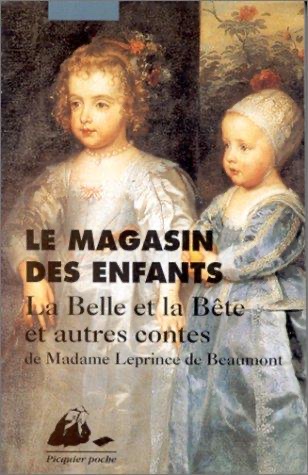
Cover of Le Magasin des enfants

Le Magasin des enfants

Jeanne-Marie Leprince de Beaumont

4 ideas

  1. Beauty chooses the Beast for his goodness

    A ruined merchant plucks a rose for his youngest daughter, Beauty, from the Beast's garden and is condemned to die unless a daughter takes his place; Beauty goes voluntarily, and each night the Beast asks her to marry him and she refuses. Her envious sisters trick her into overstaying a home visit, and she returns to find the Beast dying of grief; she declares that his kindness outweighs his ugliness and agrees to marry him. He becomes a prince, and the sisters are turned into conscious statues until they correct their faults.

  2. Character outweighs beauty and wit in a spouse

    Beauty says outright that a husband's good-heartedness, gratitude and gentleness make a happier marriage than handsomeness or cleverness, which fade or turn against the wife. The tale teaches young girls, who may face arranged marriages, to judge a partner by conduct over time rather than by surface qualities.

  3. Tale, then questioning, then self-application

    The governess tells a short story, a Bible episode or a lesson in natural history, then questions each pupil about what it means and asks how it applies to her own recent behavior. Knowledge and moral correction come in one sequence. Pupils draw the conclusion themselves under guided questioning rather than receiving it as a rule.

  4. Each pupil embodies a correctable flaw

    The pupils are drawn as distinct temperaments, such as the vain, the proud-witted and the frivolous, and the governess adjusts praise, rebuke and choice of story to each child's particular fault. Education becomes a diagnosis of the individual character rather than a uniform curriculum. The same lesson lands differently depending on the vice it has to cure.

Save and mark ideas in the app