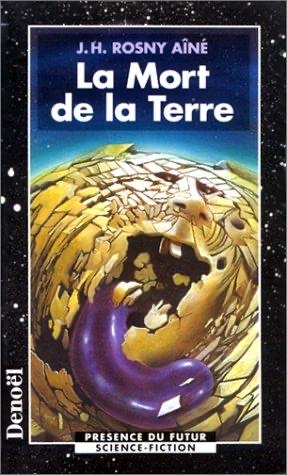
Cover of La Mort de la Terre

La Mort de la Terre

J.-H. Rosny aîné

4 ideas

  1. Targ, the last man, joins the ferromagnetals

    Earth has dried out because seismic shifts drained its water into the crust. The last humans cling to a few shrinking oases, and one by one they accept voluntary euthanasia. Targ, a watchman who has fought to find water and keep his people alive, ends up alone, lies down among the iron-based ferromagnetals, and lets the iron in his body pass into the new form of life.

  2. Ferromagnetals: a mineral kingdom succeeding biology

    The ferromagnetals are a new kind of life built on iron and magnetism rather than carbon and water. They emerged from the metallic residue that human industry scattered across the planet. They thrive in the dry, water-poor conditions that are killing organic life and draw the iron they need from their surroundings, including from human bodies. Humanity's own technological by-products thus become the substrate of the species that inherits the Earth.

  3. Species end through slow attrition, not catastrophe

    Humanity's end comes from gradual loss of its one critical resource, water, spread over generations, rather than from a single disaster. As the margin of survival narrows, the survivors lose the will to reproduce and to struggle. Collective resignation completes what environmental decline began.

  4. Humanity as one transitional phase of life

    The novel refuses to treat humans as life's endpoint and presents them as one stage in a longer planetary succession of life forms. From this vantage, the death of the last human is a handover rather than the end of meaning: the matter and energy that made people up are taken into the organisms that follow.

Save and mark ideas in the app