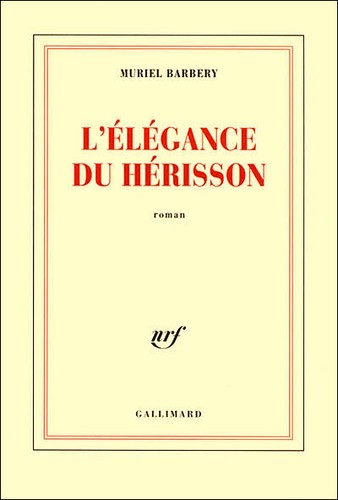
Cover of The Elegance of the Hedgehog

The Elegance of the Hedgehog

France · 2000s

8 ideas

Buy on Amazon

In a Paris apartment building, concierge Renée Michel keeps her love of books hidden from the wealthy residents. Upstairs, twelve-year-old Paloma Josse conceals a grave decision of her own. Moving between their perspectives, Muriel Barbery’s novel asks what the people in this building can see in one another.

  1. Concierge, suicidal girl, and Japanese newcomer

    At 7 rue de Grenelle in Paris, the widowed concierge Renée Michel reads Tolstoy and Husserl in secret and leaves a television on in her lodge so the wealthy residents will believe she is dull. Twelve-year-old Paloma Josse, who despises the emptiness of her bourgeois family, plans to kill herself and set fire to the apartment on her thirteenth birthday. The new resident Kakuro Ozu sees through Renée when she echoes the opening line of Anna Karenina, and a friendship forms among the three. Soon after, Renée is struck and killed by a dry-cleaning van while running to help a homeless man, and her death leads Paloma to abandon her suicide plan.

  2. Hedgehog elegance as defensive concealed refinement

    Paloma describes Renée as having the elegance of the hedgehog: she is prickly and unappealing on the outside, fortress-like, but deeply refined within. The spines are a strategy, not a temperament. By performing the coarse concierge the residents expect, Renée protects her inner life from their scrutiny and contempt.

  3. Class assigns roles people refuse to see past

    The residents never see Renée herself. They see the function of concierge, and they cannot register evidence that contradicts it. Renée hides because she believes crossing class lines is punished, a fear shaped by her sister Lisette, who was seduced and abandoned by a rich man's son. Invisibility is imposed by the observers' expectations and then reinforced by the observed person's fear.

  4. Meaning lives in brief moments of beauty

    The novel argues that a life can be justified by rare suspended moments of beauty, such as a camellia on moss or a perfect gesture, even if no larger purpose exists. Paloma's journals search for these moments against a world she finds absurd. After Renée's death she concludes that we must look for the "always" within the "never", so a fleeting moment can outweigh despair.

  5. Concierge who hides her erudition

    Renée Michel, 54, the widowed concierge of an upscale building at 7 rue de Grenelle, reads Tolstoy, Husserl and Kant and watches Ozu films in her back room, but keeps a television blaring in the front so the wealthy residents see only the dull, grumpy concierge they expect. Kakuro Ozu, a new Japanese tenant, recognizes her when she echoes the opening line of Anna Karenina. Their friendship ends her concealment, and soon after she is killed by a laundry van while running to help a homeless man.

  6. Social invisibility follows role expectations

    People do not see the individual in a service role. They see the category, so any trait that contradicts the stereotype is filtered out or goes unregistered. Renée's disguise works because the residents' assumptions do the concealing for her, and it fails only when someone arrives without those class expectations.

  7. The hedgehog: prickly shell, refined interior

    The hedgehog image describes a person who guards an inner life with a defensive, off-putting exterior. The rough shell hides nothing shameful. It protects something refined from an environment likely to mock or misread it. The cost is that the same armor that prevents contempt also blocks recognition by anyone who could appreciate what is inside.

  8. Moments of beauty as reason to live

    The twelve-year-old Paloma has concluded that adult life is a pointless fishbowl and plans to set fire to her family's apartment and kill herself on her thirteenth birthday. Meanwhile she keeps journals of 'profound thoughts' and of 'the movement of the world', hunting for evidence against her plan. The lens places meaning in brief, concrete instants of grace, like a camellia on moss or a perfect gesture, which she calls 'always within never'. Her search for these moments, and the people who produce them, is what dissolves her despair.

Save ideas and give them a thumbs up or down in the app