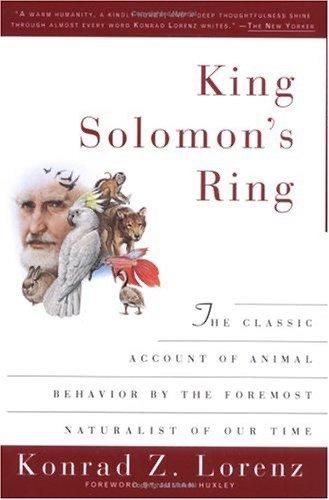
Cover of King Solomon's Ring

King Solomon's Ring

Konrad Lorenz

4 ideas

  1. Crouching, quacking man leads mallard ducklings

    Lorenz hatched mallard ducklings in an incubator and found they would not follow him, although greylag goslings readily did. When he crouched low and kept up a continuous mallard-like quacking, they followed him, showing that the ducklings needed the right call and not merely a moving figure. He then had to waddle squatting and quacking through his garden for hours, to the bewilderment of onlookers who could not see the ducklings hidden in the grass behind him.

  2. Imprinting fixes attachment in a window

    In certain birds, the object of the young animal's following and social attachment is not inborn. It is fixed by exposure to a suitable stimulus during a short sensitive period shortly after hatching. Once formed, this bond is largely irreversible, so a gosling raised by a human treats humans, not geese, as its own kind.

  3. Jackdaws mob man carrying black trunks

    Lorenz was once carrying his wet black swimming trunks when his tame jackdaws, which normally trusted him, attacked his hand with a rattling alarm call. The trigger was not the man but a dangling black object, the sign stimulus that normally means 'a jackdaw is being carried off by a predator.' An innate defence response can be released by a crude cue, whatever the actual situation.

  4. Dangerous weapons evolve with matching inhibitions

    Lorenz argued that species with lethal natural weapons, such as wolves and ravens, evolve strong inhibitions against killing their own kind, and these inhibitions are triggered by submission gestures from the loser. Weakly armed species like doves never needed such brakes, so a dove caged with a rival that cannot escape may peck it to death. He warned that humans are a weakly armed species that acquired artificial weapons without the corresponding inhibition.

Save and mark ideas in the app