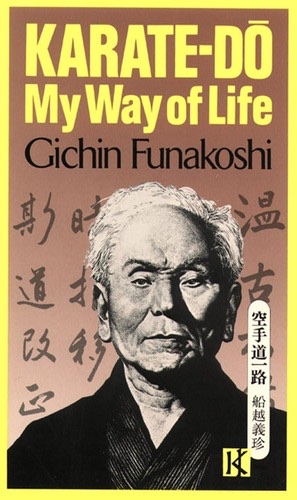
Cover of Karate-Do: My Way of Life

Karate-Do: My Way of Life

Gichin Funakoshi

4 ideas

  1. Horse stance on a rooftop during a typhoon

    As a young man in Okinawa, Funakoshi climbed onto his roof during a violent typhoon, took a low horse stance, and held up a straw mat against the gale to test his training against nature's force. He was blown off repeatedly into the mud and climbed back up each time. He later offered it as an example of youthful excess that nonetheless shows how he treated his body and will as things to be tested against real resistance, not only in the practice hall.

  2. There is no first attack in karate

    Funakoshi's maxim 'karate ni sente nashi' holds that a trained fighter never strikes first, and that the art's purpose is to make fighting unnecessary, not to win fights. Skill works mainly as restraint: the more capable you are of harm, the greater your duty to avoid situations that call for it, so a real confrontation counts as a failure of judgment even when you win it.

  3. Renaming 'China hand' to 'empty hand'

    Funakoshi changed the written character for 'kara' in karate from the one meaning 'China' to the one meaning 'empty.' This moved the art's identity from a foreign lineage to a Japanese one and gave it a moral meaning. 'Empty hand' means both fighting without weapons and emptying the self of selfishness and ill intent, the way a clear mirror or a quiet valley reflects and echoes what comes to it without distortion.

  4. Years on one kata before the next

    The method treats depth of repetition as the way to real understanding: a form reveals its principles only after it has been internalized so fully that it no longer needs conscious thought. Collecting many forms shallowly builds the look of skill without its substance.

Save and mark ideas in the app