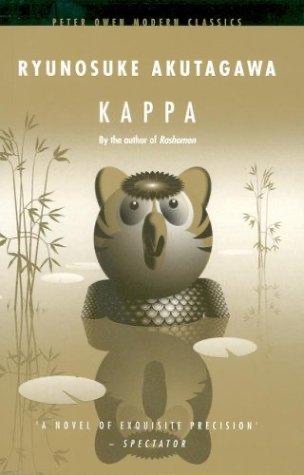
Cover of Kappa

Kappa

Ryūnosuke Akutagawa

4 ideas

  1. The unborn kappa declines to be born

    In kappa land a father presses his mouth to the pregnant mother's body and asks the fetus whether it wishes to be born into this world. Bag's unborn child refuses, citing its father's hereditary insanity and its belief that kappa existence is evil, and the mother's swollen belly deflates as the midwife injects a fluid. The episode stages procreation as an act that ordinarily imposes existence on a being who never consented to it.

  2. Legalized euphemism makes economic brutality seem painless

    When machines displace tens of thousands of kappa workers, the unemployed are slaughtered under a 'Workers Slaughter Law' and their meat is sold as food, and the kappa call this humane because it spares the state strikes and poverty relief. The satire holds that a society can accept the destruction of surplus labour calmly once the process is codified, given a neutral name, and made efficient. Human industrial society does the same thing slowly, through starvation and suicide rather than the butcher.

  3. Inverted customs expose the arbitrariness of norms

    The kappa laugh at what humans take seriously and take seriously what humans laugh at, on matters such as justice, family and shame. Seeing familiar institutions performed backwards by another species shows that human morals are conventions sustained by habit rather than reason. The inversion also leaves no clean alternative, because the kappa version is just as absurd.

  4. The returnee who finds humans unbearable

    The narrator, Patient No. 23 in an asylum, fell into a ravine near Kamikōchi while hiking and lived among the kappa. After returning to Japan he found the smell and faces of humans repellent, lost his business, and tried to go back to kappa land. The frame shows the outsider-observer's clarity being reclassified by society as madness.

Save and mark ideas in the app