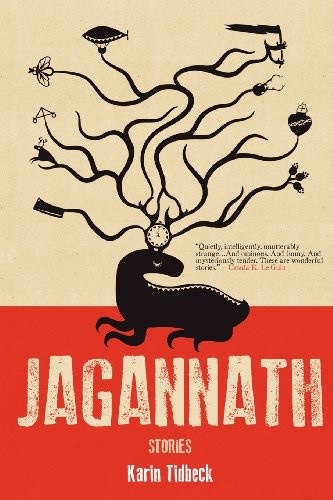
Cover of Jagannath

Jagannath

Karin Tidbeck

5 ideas

  1. Ninety-Three inside the dying Mother

    Its human inhabitants are workers whose whole existence is tending its digestion and internal chambers, and they understand no world outside it. When Mother's journey ends and the organism begins to die, the community's entire cosmology collapses, because the host was also the only frame of meaning they had.

  2. One impossible rule, rigorously obeyed

    Each story posits a single impossible premise, then refuses to explain or undermine it. Everything else follows logically from that rule. The strangeness persuades through internal consistency, and consequences carry the weight that exposition usually would.

  3. Uncanniness comes from characters' calm acceptance

    The characters treat bizarre conditions as ordinary: aunts who eat until they burst, a man who drifts upward, a family housed in an organism. Nobody in the story registers horror, so the reader must supply it. That transfer produces a colder unease than overt shock would.

  4. Switchboard operators impersonating the lost

    In 'Who Is Arvid Pekon?', Arvid works at a government switchboard. His job is to impersonate whomever a caller hopes to reach, including absent or dead loved ones, using his voice to supply the expected person. The job empties out his own identity, so that the self becomes a role performed for others' need.

  5. Mock-scholarly form for invented creatures

    'Pyret' presents a fictional shapeshifting creature through the apparatus of academic writing: sources, folklore records and cautious hedging. The borrowed authority of scholarly prose makes the invented creature feel documented rather than imagined. The form itself becomes evidence that the thing is real.

Save and mark ideas in the app