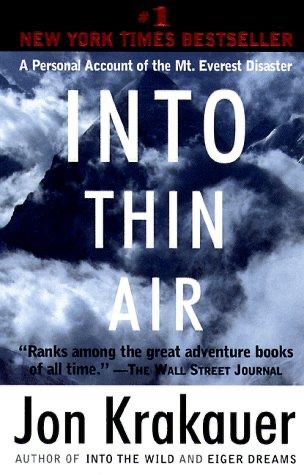
Cover of Into Thin Air

Into Thin Air

Jon Krakauer

4 ideas

  1. Rob Hall's broken turnaround time, 1996

    On May 10, 1996, guide Rob Hall had set a 1 or 2 p.m. turnaround time for his clients, then stayed near the summit past 4 p.m. to get client Doug Hansen, who had failed to summit the year before, to the top. A storm hit during the descent.

  2. Commercial guiding corrupts the judgment to turn back

    Once clients pay around $65,000 and guides compete for reputation and future business, a failed summit becomes a commercial loss as well as a disappointment. The guide's duty to say no is quietly traded against the client's demand for a result. Krakauer argues that this pressure, together with inexperienced clients who could not look after themselves, turned a survivable storm into a mass casualty event.

  3. Summit fever and hypoxic judgment

    Above 8,000 meters, oxygen deprivation degrades reasoning just when the most consequential decisions have to be made. Climbers near the top also fixate on the goal after so much investment. Because the impaired mind cannot notice its own impairment, rules have to be set in advance at lower altitude, such as fixed turnaround times, and then obeyed mechanically rather than reconsidered in the moment.

  4. Participant-witness memory is unreliable and self-implicating

    Krakauer found that his own eyewitness account was wrong: he reported that guide Andy Harris had reached camp safely, when Harris had in fact been lost high on the mountain, and his mistaken report shaped what others believed and did. Reading a survivor's testimony with this in mind means weighing it as the product of exhausted, oxygen-starved perception and of guilt, not as a neutral record. Testimony from a participant can be vivid and still distorted in ways the witness cannot detect.

Save and mark ideas in the app