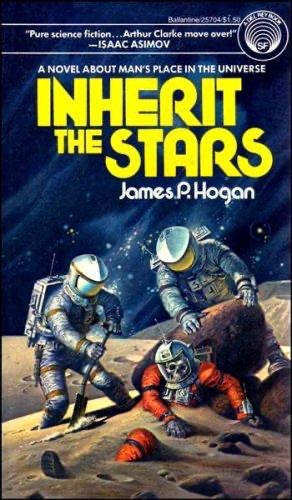
Cover of Inherit the Stars

Inherit the Stars

James P. Hogan

4 ideas

  1. Charlie: the 50,000-year-old astronaut on the Moon

    Explorers find a spacesuited human corpse, nicknamed Charlie, in a lunar cave and date it to 50,000 years old, long before any human civilization. Physicist Victor Hunt coordinates biologists, linguists and engineers under UNSA. Charlie's decoded diary and a 25-million-year-old alien ship found on Ganymede lead to the answer: Charlie's people, the Lunarians, lived on a lost planet, Minerva, whose destruction left the asteroid belt. Minerva's moon was captured by Earth, and Lunarian survivors who landed on Earth became the ancestors of modern humans.

  2. Treat every contradiction as a constraint

    When well-established facts appear mutually exclusive, don't discard the inconvenient ones or split into camps defending each. Assume all of them are true and search for the single model that satisfies every one at once. The contradiction marks exactly where a hidden premise is wrong. This work needs an integrator who holds the whole problem in view and is not loyal to any one specialty's conclusions.

  3. Identical anatomy proves common descent

    The biologist Danchekker argues that independent evolution on two worlds cannot produce the same species down to the fine details. Charlie must therefore share ancestry with Earth life, however impossible the logistics seem. His point is that the most rigorous, well-grounded constraint should anchor the investigation even when it forces absurd-seeming conclusions elsewhere, and in the novel it proves correct.

  4. The unlisted assumption is the culprit

    The mystery breaks only when someone questions a premise so basic that no one had written it down: that the Moon has always been Earth's moon. When every stated hypothesis fails, look for the background belief shared by all sides. It went unexamined precisely because everyone agreed on it.

Save and mark ideas in the app