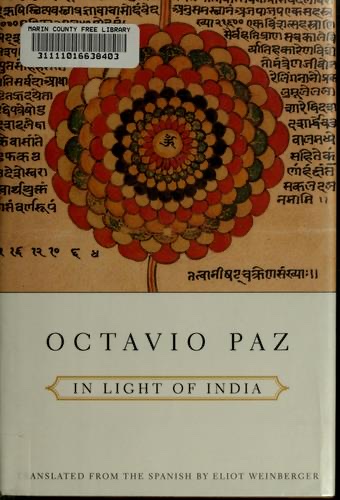
Cover of In Light of India

In Light of India

Octavio Paz

5 ideas

  1. Poet-ambassador who resigned over Tlatelolco

    Paz first arrived in Bombay in 1951 as a young Mexican diplomat and returned in 1962 as Mexico's ambassador to India. He held the post until October 1968, when he resigned in protest after the Mexican government massacred student demonstrators at Tlatelolco. The book, written decades later, reconstructs India through that lived diplomatic and personal experience rather than through academic study.

  2. Juxtaposition versus fusion: caste against mestizaje

    Spanish colonization of Mexico produced mestizaje, a mixing of peoples, beliefs and bloodlines into a new hybrid identity. India handled newcomers by juxtaposition instead: each invading or converted group was slotted in as another separate compartment that coexisted without merging. The same encounter of civilizations can yield either a blended society or a mosaic of sealed units, depending on the host's social mechanism.

  3. Caste as a federation of self-governing communities

    Paz argues that caste is not only a hierarchy of oppression but a network of semi-autonomous jatis, each with its own rules, trades, courts and sense of belonging. This decentralized structure let Hindu society survive centuries of Muslim and British rule, because conquerors could seize the state without dissolving the social fabric beneath it. The same resilience fragmented loyalty and blocked the formation of a unified political community.

  4. Hinduism and Islam coexisted but never merged

    Hinduism is plural, absorptive and polytheistic, while Islam is a strict monotheism that rejects images and multiple gods, so their premises could not be reconciled. Centuries of coexistence without fusion laid the groundwork for Partition in 1947.

  5. India as civilization, not nation

    Paz reads India as a civilization, a vast continuity of religions, languages and customs, rather than a nation in the European sense of one people, one language and one state. The modern secular state Nehru built is therefore a Western import laid over an older, non-national order. Much of India's political tension comes from the friction between these two layers.

Save and mark ideas in the app