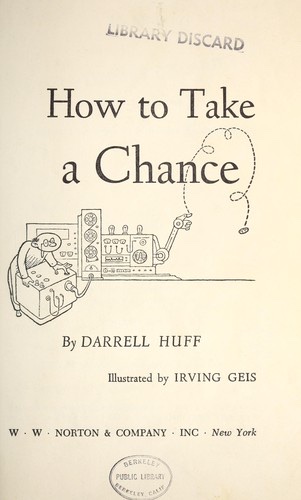
Cover of How to Take a Chance

How to Take a Chance

Darrell Huff

6 ideas

  1. Dice and coins have no memory

    Each independent trial of a fair coin or die carries the same odds regardless of prior outcomes, so a run of heads makes tails no more 'due.' The gambler's fallacy arises from treating the law of averages as a corrective force acting on the next toss, when it works only by swamping early deviations with many later trials.

  2. Law of averages works by dilution

    As trials accumulate, the proportion of heads drifts toward one half even though the absolute gap between heads and tails may grow. Convergence happens because early streaks become a shrinking fraction of the total, not because the process compensates for them.

  3. Counting equally likely outcomes for odds

    To find a probability, list all equally likely outcomes and divide the favorable ones by the total, as with the 36 combinations of two dice, where 7 appears six ways and 2 or 12 only one way each. Errors typically come from treating unequal outcomes, such as 'a sum of 7' and 'a sum of 12,' as if they were equally likely.

  4. Chevalier de Méré's dice wager puzzle

    A 17th-century gambler noticed that betting on at least one six in four rolls of a die paid off, but betting on at least one double six in twenty-four rolls of two dice lost money, despite his proportional reasoning saying they were equal. Pascal and Fermat's correspondence resolving this and related puzzles is treated as the birth of formal probability theory.

  5. Coincidences are expected across many opportunities

    An event that is wildly improbable for a specific person at a specific moment becomes nearly certain when counted across everyone and every occasion it could have happened. Striking coincidences, like shared birthdays in a small group, surprise us because we judge the odds for the specific case instead of for any case.

  6. House edge guarantees long-run gambler losses

    Casino games and betting systems are built so that expected value favors the house on every wager, and no staking pattern such as doubling after losses can change the sign of that expectation. Such systems only redistribute outcomes into many small wins and occasional ruinous losses, which betting limits and finite bankrolls make inevitable.

Save and mark ideas in the app