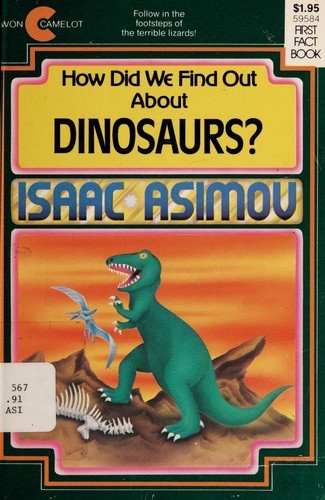
Cover of How Did We Find Out About...

How Did We Find Out About...

Isaac Asimov

4 ideas

  1. Pasteur's swan-neck flask ends spontaneous generation

    In the early 1860s Louis Pasteur boiled broth in flasks whose long necks he had bent into an S-curve. The necks stayed open to the air, but dust and microbes settled in the bend. The experiment showed that microorganisms come from other microorganisms carried on dust, not from the air or the broth itself, which laid the groundwork for germ theory.

  2. Discovery is a chain, not a flash

    A scientific discovery is usually a long relay of partial steps. New instruments, failed hypotheses and small observations each make the next step possible. Leeuwenhoek saw microbes through his lenses in the 1670s, yet the link between germs and disease took about two more centuries of intermediate work to establish. Crediting one genius hides the sequence of reasoning that actually produced the knowledge.

  3. Inferring invisible entities from measurable regularities

    Scientists can establish that something exists before anyone sees it, when it is the simplest explanation for a regular pattern in measurements. Around 1803 John Dalton argued for atoms because elements combine in fixed weight ratios. When two elements form more than one compound, those ratios come in small whole numbers, which is exactly what indivisible units of fixed weight would produce. The atom was accepted as the cause of the numbers long before it could be observed directly.

  4. Teach how we know, not what

    Science is presented here as the chain of evidence and argument that justifies a fact, not as a list of facts. Following each step shows a reader why the conclusion earned belief and why earlier answers were rejected. This makes the method itself transferable to new questions.

Save and mark ideas in the app