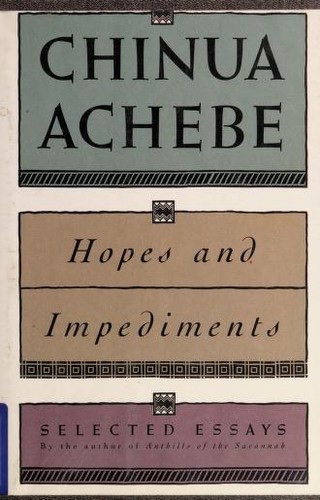
Cover of Hopes and Impediments

Hopes and Impediments

Chinua Achebe

5 ideas

  1. Achebe's 1975 Amherst lecture on Conrad

    In February 1975, in a lecture at the University of Massachusetts Amherst, Achebe argued that Joseph Conrad was 'a thoroughgoing racist' and that Heart of Darkness sets Africa up as 'the other world', a foil against which Europe's own civilization is measured. He cites the novel's Africans, who are denied coherent speech and appear as 'limbs' and 'rolling eyes', and contrasts them with the one African woman used as a savage counterpart to Kurtz's European Intended. He concludes the book should not be taught as a great work of art, because it dehumanizes a portion of the human race.

  2. Africa as foil for European self-image

    Western writing has repeatedly used Africa as a background or mirror against which Europe can feel its own spiritual grace. Africa's function is to show what Europe might fall back into, so the place and its people are emptied of their own reality and turned into a prop for someone else's moral drama. The need for this image is Europe's psychological need, not a description of Africa.

  3. Aesthetic greatness cannot excuse dehumanization

    A work's stylistic power or its ironic framing, such as Conrad's use of Marlow as an unreliable narrator, does not neutralize its dehumanizing content. If the author offers no alternative frame of reference from which to judge the narrator's view, the distance is only cosmetic. A book that denies humanity to a group of people cannot be called great art, however skillful it is.

  4. The novelist as teacher of dignity

    In a society whose confidence was damaged by colonialism, the writer has an educational task: to help people regain belief in themselves and to show that their past was not 'one long night of savagery'. Achebe frames this as re-education, not propaganda, and says he would be satisfied if his novels only taught readers that their past had dignity. On this view, art that claims to be free of social purpose is a luxury the colonized cannot afford.

  5. Whose story sets the terms of reality

    Look at any account of a people by asking who is telling it and whom it leaves voiceless. Achebe treats stories as instruments of power: whoever controls the narrative controls how a people is seen, and even how they see themselves. So the answer to a distorting story is not silence but a counter-story told from inside the culture.

Save and mark ideas in the app