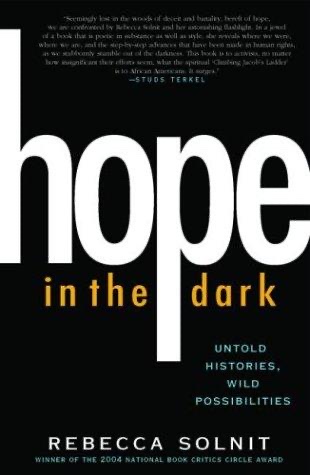
Cover of Hope in the Dark: Untold Histories, Wild Possibilities

Hope in the Dark: Untold Histories, Wild Possibilities

5 ideas

Buy on Amazon
  1. Hope as action amid uncertainty

    Hope is not optimism that things will turn out well, nor pessimism that they will not; both are certainties that excuse inaction. Hope is the recognition that the future is genuinely unknown, and that uncertainty is itself the ground for acting, because outcomes are not yet decided.

  2. Indirect and delayed effects of action

    Political actions rarely produce the direct, immediate results activists aimed for, so by that narrow measure they look like failures. Judged over longer time and across unexpected channels, their effects ripple outward: shifting what is sayable, inspiring distant movements, and surfacing years later, so the metric of immediate victory systematically undercounts impact.

  3. Memory of defeat erases victories

    Activists and the public tend to remember losses and forget the wins, which breeds a despair that says resistance never works. This amnesia is politically consequential: recovering the buried record of successful movements is itself a precondition for continuing to act.

  4. The Berlin Wall's unforeseen 1989 fall

    The sudden collapse of the Berlin Wall and the Eastern Bloc in 1989 was anticipated by virtually no expert or intelligence agency, yet it grew from decades of dissident organizing that had looked futile. Solnit uses it as evidence that entrenched power can dissolve abruptly and that slow, apparently fruitless groundwork can precede rapid, unpredicted change.

  5. The dark as generative, not fearful

    Reframe 'the dark' of an unknown future not as a threat but as the obscurity of a seed underground or a pregnancy: the place where things that cannot yet be seen are being formed. This treats not-knowing-the-outcome as the normal condition from which new possibilities emerge rather than a reason for paralysis.

Save ideas and give them a thumbs up or down in the app