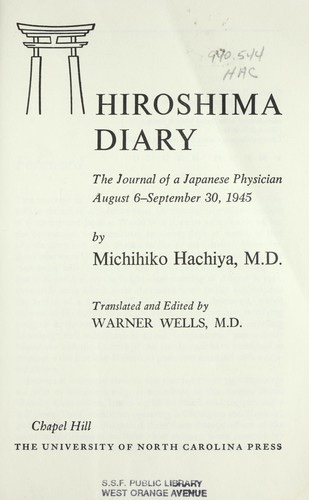
Cover of Hiroshima Diary

Hiroshima Diary

Hachiya Michihiko

7 ideas

  1. Wounded director runs the Communications Hospital

    On 6 August 1945 Hachiya Michihiko, director of the Hiroshima Communications Hospital about 1.5 km from the hypocenter, was cut by flying glass at home and made his way, stripped and bleeding, to his own hospital. He lay there as a patient while the damaged building filled with hundreds of burned and dying people. From his bed he kept directing the staff, and he wrote a daily record through 30 September.

  2. Diagnosing an unknown disease without official information

    Cut off from official information, Hachiya's staff first read the unfamiliar symptoms through known categories such as dysentery or poison gas. They then revised their view as data built up: petechiae, hair loss, bleeding gums, collapsing white blood cell counts and autopsy findings. Correlating symptom severity with each patient's distance from the hypocenter let them recognize a new radiation-caused illness through bedside pattern-matching before any authority explained it.

  3. Pika versus pikadon: distance encoded in naming

    Survivors named the bomb by what they perceived. Those close to the center recalled only 'pika' (the flash), while those farther away experienced 'pikadon' (flash plus boom). The vocabulary a population invents for a disaster can preserve each speaker's physical relation to it and act as an informal spatial record of exposure.

  4. Rumor fills the vacuum of silence

    Without trustworthy news, the ward ran on rumor. Stories swung between fears of further attacks and fantasies of Japanese retaliation with an equal weapon, and the Emperor's surrender broadcast landed as a shock that provoked anger and grief. When authorities go silent in a catastrophe, rumor becomes the medium through which people process fear and hope. Tracking rumors therefore reveals a community's emotional state more than the actual facts.

  5. Diagnosing an unnamed disease from scratch

    With no theory of radiation injury available, Hachiya's staff built one by pattern-matching at the bedside. Falling white counts and the patient's distance from the hypocenter at the moment of the flash turned out to predict who would die, which turned an invisible cause into a usable prognosis.

  6. Delayed casualties invert visible triage logic

    Many survivors who walked away with minor wounds, or none, collapsed weeks later with bleeding, hair loss and infection, while some badly burned patients lived. Visible injury therefore failed as a measure of harm. Apparent recovery gave false reassurance, and the true scale of the bombing kept growing after the event itself had ended.

  7. Rumor fills a collapsed information system

    With communications destroyed and no official explanation, the hospital's knowledge came from visitors' hearsay. Theories included poison gas, a new bomb that would leave the city uninhabitable for decades, and imminent further attacks, and each one shifted morale and behavior. Even the name survivors gave the weapon depended on where they had stood: those close by remembered only the flash ('pika'), while those farther away said 'pikadon,' flash-boom.

Save and mark ideas in the app