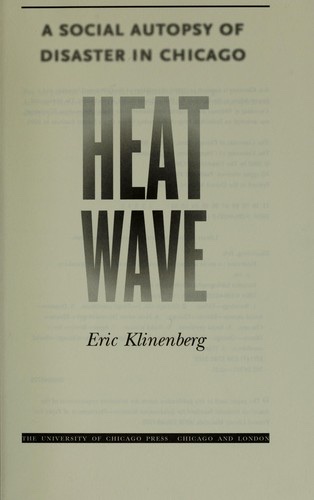
Cover of Heat Wave

Heat Wave

Eric Klinenberg

6 ideas

  1. Social autopsy of a disaster

    A social autopsy treats a mass death event the way a medical examiner treats a body, tracing mortality back to the social conditions, institutions and policies that made certain people vulnerable. The immediate cause, heat, is treated as a trigger. The real explanation lies in how the city was organized before the disaster arrived, which determined who was exposed and who was abandoned.

  2. North Lawndale versus Little Village mortality

    Two adjacent West Side Chicago neighbourhoods had nearly identical climates and similar poverty levels, yet predominantly Black North Lawndale had one of the highest heat death rates and predominantly Latino Little Village one of the lowest. North Lawndale's population loss, abandoned lots, closed businesses and fear of crime kept elderly residents locked inside. Little Village's dense commercial streets, busy sidewalks and family networks drew people outdoors and into contact with others who could check on them.

  3. Isolation kills through spatial and social abandonment

    Many victims died alone behind locked doors and sealed windows. They were afraid of crime, cut off from kin, and living in neighbourhoods with no street life or public places to go. Social isolation was not simply personal loneliness. Depopulation, disinvestment and the decay of public space produced it and made the old and poor invisible when they most needed help.

  4. Entrepreneurial state shifts rescue onto citizens

    Chicago's reorganized city services expected residents to act as 'smart consumers' of government, seeking out help on their own. That design fails the people least able to navigate it: the frail, the isolated and the distrustful. When public agencies wait to be asked instead of reaching out, vulnerability decides who gets saved.

  5. Media framing naturalized a political failure

    News outlets covered the heat wave mainly as a weather story and a spectacle, with images of overflowing morgues and human-interest stories. They gave little structural analysis. City officials disputed the death counts and blamed victims for not caring for themselves. Together these framings recast predictable deaths as a natural act rather than a consequence of policy and neglect.

  6. Invisible disasters of the marginal

    Some catastrophes leave no dramatic physical damage. Heat destroys no buildings, so its victims die quietly and dispersed across the city. That invisibility lets society overlook the ongoing, everyday conditions of poverty, age and isolation that the crisis only briefly intensified and exposed.

Save and mark ideas in the app