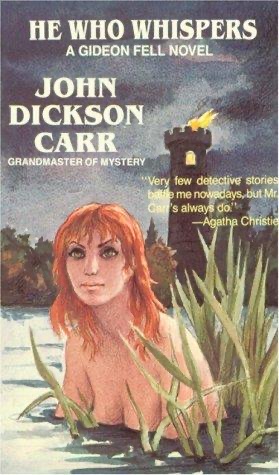
Cover of He Who Whispers

He Who Whispers

John Dickson Carr

4 ideas

  1. The tower stabbing at Chartres, 1939

    In pre-war France, Howard Brooke is found stabbed with a sword-stick on top of a stone tower on his estate near Chartres. Witnesses place no one else on the tower, so the crime looks physically impossible, and suspicion settles on Fay Seton, a young Englishwoman already rumoured locally to be a vampire. Years later, after the war, the case is retold to a London murder club, and Dr. Gideon Fell shows that the impossibility had an ordinary human explanation.

  2. Whispering campaign as untraceable weapon

    An accusation that is only whispered, never stated openly, cannot be rebutted, because there is no formal claim to answer and no identifiable accuser to confront. It ruins the target's reputation and can break her mind while the whisperer stays invisible and deniable. Insinuation therefore does damage that direct accusation cannot, because the victim is denied any forum in which to defend herself.

  3. Impossibility lives in the witness's assumptions

    A crime seems impossible only because observers take for granted a premise about who was where, when, and how the wound was made. The rational method does not ask what supernatural force could do this. It asks which unexamined assumption, if false, would make the event ordinary. Removing that single false premise dissolves the miracle.

  4. Supernatural rumour attaches to the outsider woman

    When evidence is ambiguous, a community fills the gap with the monstrous explanation that fits its existing resentments, and these are often sexual jealousy or distrust of an attractive stranger. The vampire label is less a belief about the supernatural than a socially acceptable way to expel someone the group already wanted rid of. Irrational charges, once attached, persist even after rational explanations are offered.

Save and mark ideas in the app