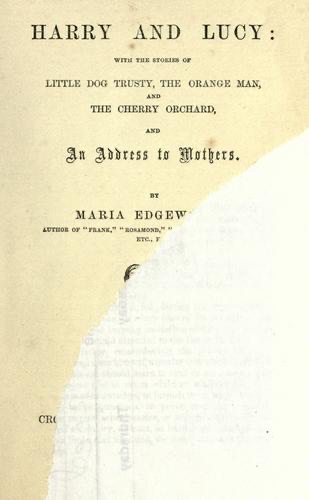
Cover of Harry and Lucy

Harry and Lucy

Maria Edgeworth

4 ideas

  1. Household objects become the science laboratory

    Harry and Lucy learn natural philosophy almost entirely from things already in their home and street: a boiling kettle and its steam, a thermometer whose quicksilver rises when warmed, fire, levers, and workmen raising heavy loads. When a child asks why something happens, the father or mother does not lecture. They set up a small test with those same objects and walk the child through what was observed.

  2. Withhold the answer until the child reasons

    The parents often refuse to give an explanation straight away. They first make the child guess, predict what will happen, and check the guess against an experiment. The book holds that an answer a child reaches this way is understood and kept, while an answer simply handed over is only memorized as words.

  3. Thing first, name second

    A scientific term such as 'expansion,' 'evaporation,' or 'lever' is introduced only after the child has seen and handled the phenomenon it describes. The word then labels an experience the child already has, not a definition to be decoded. This stops children from mistaking fluent vocabulary for knowledge.

  4. Accuracy and patience as trained habits

    The two children think differently: Lucy tends to jump quickly to conclusions, while Harry is more deliberate and mechanical. The parents correct hasty or careless statements in both of them. The book treats exact observation, precise wording, and willingness to wait for proof as habits built through daily correction, not as fixed talents, so how a child learns matters as much as the facts learned.

Save and mark ideas in the app