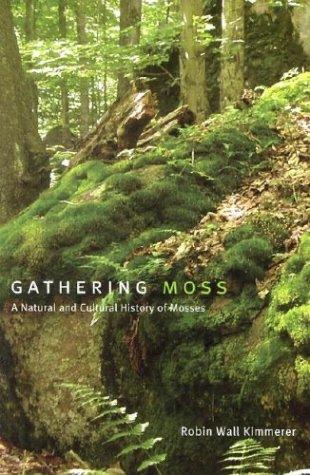
Cover of Gathering Moss

Gathering Moss

Robin Wall Kimmerer

5 ideas

  1. The boundary layer as moss habitat

    Air moving over any surface slows to near stillness in a thin layer against it because of friction, and that layer stays warmer, moister, and calmer than the air just above. Mosses, a few millimeters tall, live inside this layer. Their small size is not a failure to grow bigger but a precise fit to a microclimate that larger plants cannot occupy.

  2. Attention trains the eye to see

    Mosses are all around us but go unseen until we learn to distinguish and name them. Once someone has a reason to look closely, such as a name, a question, or a hand lens, what was a green blur becomes many distinct species. Perception is a skill built by attention and intimacy, not a passive recording of what is there.

  3. Tetraphis switching reproduction on rotting stumps

    Kimmerer's long-term study of the moss Tetraphis pellucida on decaying stumps found that colonies change how they reproduce depending on density. Sparse colonies make asexual gemmae that fill open space quickly, while crowded colonies switch to spore-producing sexual reproduction that disperses far. Small disturbances, like bark or soil falling onto the stump, reopen patches and keep the cycle going.

  4. Science and Indigenous knowledge as complementary

    Scientific method gives mechanistic knowledge by standing apart from its subject and asking how it works. Potawatomi traditional knowledge asks what a being's role is and what we owe it, treating each organism as a relative with its own gift. Kimmerer argues that together they give a fuller understanding than either alone, because objectivity without relationship leaves out responsibility.

  5. Desiccation tolerance as patient resilience

    Mosses cannot hold water in roots or a waxy cuticle, so they let themselves dry out almost completely and go dormant, then resume photosynthesis within minutes of rewetting. Their resilience comes from giving in to conditions and waiting, not from resisting them. The strategy lets them survive on bare rock and other surfaces where plants that must keep a steady water supply die.

Save and mark ideas in the app