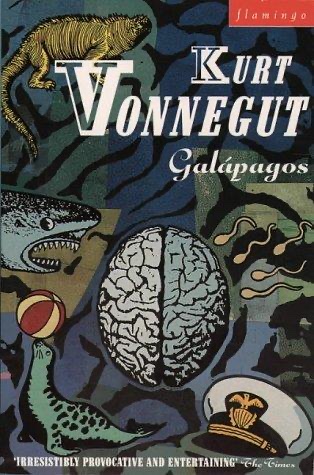
Cover of Galápagos

Galápagos

Kurt Vonnegut

4 ideas

  1. Stranded cruise passengers become humanity's ancestors

    In 1986 a global financial collapse strands the 'Nature Cruise of the Century' ship Bahía de Darwin, and its incompetent captain Adolf von Kleist runs it aground on the fictional island of Santa Rosalia with a few passengers. These include widowed biology teacher Mary Hepburn, the pregnant Hisako Hiroguchi, and six girls of the Kanka-bono tribe. A bacterium that eats human eggs then sterilizes everyone else on Earth. Mary secretly inseminates the Kanka-bono women with the captain's sperm, so this accidental, unselected handful becomes the entire founding stock of the human race.

  2. Oversized brains are the source of misery

    The ghost narrator argues that nearly every human catastrophe traces back to the big brain. It invents harmful schemes, believes its own lies, and can justify any cruelty or stupidity. A brain that can model endless possibilities also generates endless ways to go wrong. Over a million years, natural selection shrinks human heads, and the descendants become content, seal-like fishers who cannot plan wars or financial frauds.

  3. Catastrophe made only of changed opinion

    The financial crash that ends civilization has no physical cause: the fish, crops, and factories are unchanged. Only people's collective opinion about the value of money and paper shifts, and that shift alone produces famine and war. Big-brained societies can starve amid plenty because their survival runs through shared fictions that can evaporate overnight.

  4. Fitness is local, not progressive

    Evolution selects for whatever works in the immediate environment, not for intelligence or advancement. Seen this way, the loss of hands and intellect is successful adaptation rather than decline, and 'more advanced' becomes a human vanity rather than a biological category.

Save and mark ideas in the app