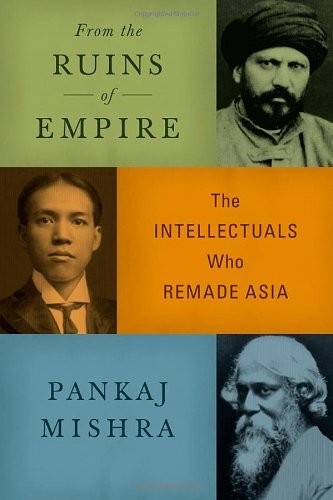
Cover of From the Ruins of Empire

From the Ruins of Empire

Pankaj Mishra

6 ideas

  1. Tsushima as Asia's shared awakening

    Japan's 1905 destruction of the Russian fleet at Tsushima was celebrated from Cairo to Calcutta to Shanghai. It was the first modern defeat of a European power by an Asian one, and colonized peoples read it as proof that white supremacy was contingent rather than natural. Figures as different as Gandhi, Nehru, Atatürk and Sun Yat-sen recalled it as a formative moment, which turned a regional war into a pan-Asian psychological event.

  2. Humiliation, not just exploitation, drove Asian revolt

    Western imperialism inflicted economic loss, but the deeper wound it left on Asian elites was humiliation. Ancient civilizations were abruptly ranked as backward, and the dominance of their own ruling classes was exposed as hollow. The sense of lost dignity, more than material grievance, became the emotional fuel of Asian nationalism and still shapes resentment toward the West.

  3. Al-Afghani's shifting pan-Islamic activism

    Jamal al-Din al-Afghani moved between Iran, Afghanistan, India, Egypt, Istanbul, Paris and London, reshaping his message for each audience. He was a rationalist reformer in one setting and a pan-Islamic mobilizer in another, and he courted rulers only to turn against them. His restless career shows how a modern political Islam first formed as a tactical response to European encroachment, not as a return to tradition.

  4. Liang Qichao's disillusionment with Western models

    Liang Qichao first championed Western-style reform, Social Darwinist competition and strong-state nationalism as China's path to survival. His 1903 trip to America and his tour of Europe after the First World War exposed him to inequality, racism and civilizational self-destruction. He came away doubting that Western modernity was worth copying wholesale.

  5. Tagore's critique of the nation-state itself

    Rabindranath Tagore argued that the Western nation was a machine for organized power and commerce that crushed moral and spiritual life. He held that Asia should not answer the West by building its own aggressive nationalism. This position left him isolated even among the anti-colonial movements he sympathized with.

  6. Asia's rise as the West's revenge

    Read the modern rise of China, India and the Muslim world as a delayed victory for the nineteenth-century thinkers who sought Western power to resist the West. The same view shows the victory to be ambiguous. Asia won by adopting the Western model of nation-states, industrial growth and mass consumption, which reproduces the ecological and social crises those thinkers foresaw.

Save and mark ideas in the app