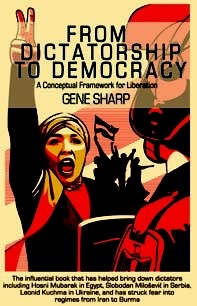
Cover of From Dictatorship to Democracy: A Conceptual Framework for Liberation

From Dictatorship to Democracy: A Conceptual Framework for Liberation

6 ideas

Buy on Amazon
  1. Power Depends on Obedience and Cooperation

    A ruler's power is not intrinsic but flows from the ongoing cooperation, obedience, and submission of the population and institutions they govern. When enough people and organizations withdraw that cooperation, the ruler's power sources dry up and their authority collapses, regardless of their weapons or apparatus.

  2. Pillars of Support Sustain Rulers

    Every dictatorship rests on identifiable sources of power: authority, human resources, skills and knowledge, intangible factors like habits of obedience, material resources, and sanctions. These sources are supplied by specific institutions and groups (police, bureaucracy, business, religious bodies), so a dictatorship weakens precisely as these suppliers restrict or sever their support.

  3. Political Defiance Over Violence or Negotiation

    Against a dictatorship, armed struggle fights on the regime's strongest terrain and negotiation surrenders leverage when you are weak, while nonviolent political defiance attacks the regime's dependence on cooperation. Choosing the weapon of struggle should be based on where the opponent is weakest and the resisters strongest, which favors mass noncooperation.

  4. Grand Strategy Beats Spontaneous Heroism

    Scattered acts of courage and spontaneous uprising tend to be crushed because they lack a strategic plan that sequences objectives and conserves the resisters' strength. Liberation requires deliberate grand strategy, campaign strategy, tactics, and methods, each chosen to shift the balance of forces over time rather than relying on moral outrage alone.

  5. Political Jiu-Jitsu Turns Repression Against Rulers

    When a regime violently represses disciplined nonviolent resisters, the brutality can rebound against it, shifting sympathy, defections, and legitimacy toward the resisters. Maintaining nonviolent discipline is what enables this reversal; violent response by resisters forfeits the asymmetry and restores the regime's justification for force.

  6. Build Independent Institutions During Liberation

    Durable democracy depends on a strong social fabric of independent groups and institutions (families, unions, religious bodies, professional associations) that can act autonomously of the state. Strengthening these loci of power during the struggle both enables effective resistance and guards against a new dictatorship arising after the old one falls.

Save ideas and give them a thumbs up or down in the app