Palace massacre and the official cover-up
That evasion, together with Gyanendra's accession, fed mass disbelief and conspiracy theories. The episode shows how a state's opacity during a crisis destroys the legitimacy it most needs at that moment.
6 ideas
That evasion, together with Gyanendra's accession, fed mass disbelief and conspiracy theories. The episode shows how a state's opacity during a crisis destroys the legitimacy it most needs at that moment.
The Shah dynasty's authority came from a constructed national myth: Prithvi Narayan Shah as unifier, and the king as Hindu sovereign and a figure treated as divine. Once the massacre made the institution look violent and secretive, that sanctity could not be rebuilt. Authority grounded in sacred aura rather than performance collapses abruptly when the aura breaks.
The 1990 Jana Andolan won multiparty democracy, but power passed to a narrow, mostly high-caste Kathmandu elite. That elite spent the following decade on party infighting, patronage and corruption while rural areas stayed neglected.
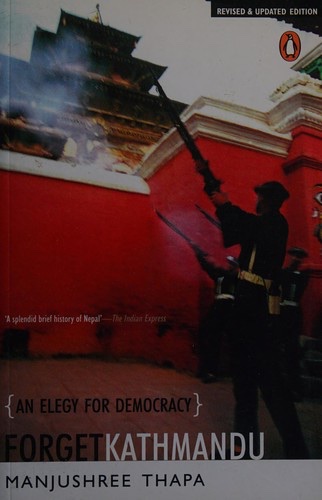
'Forget Kathmandu' asks the reader to look at the country from its hills and margins, not from the capital. Seen from there, what the capital calls national politics looks like a remote elite contest. The Maoist insurgency then reads as a predictable response to exclusion rather than an aberration.
The Maoists launched the 'People's War' in 1996 and spread through mid-western districts such as Rolpa and Rukum, where the state appeared mainly as police repression. Poverty, caste and ethnic marginalization, and brutal counterinsurgency operations handed the rebels recruits and grievances. Armed revolt fills the vacuum wherever the state offers coercion without services or representation.
Thapa walks through Maoist-controlled territory and finds villagers caught between rebel demands and army violence. Their support for the Maoists is often coerced or pragmatic rather than ideological. Her firsthand account shows that civilians in a civil war are squeezed by both sides, and that neither side's slogans describe their experience.