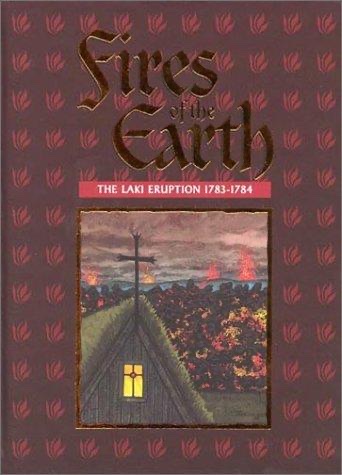
Cover of Fires of the Earth

Fires of the Earth

Jón Steingrímsson

4 ideas

  1. The Fire Sermon at Kirkjubæjarklaustur

    On 20 July 1783, as a lava stream from the Laki fissures advanced down the Skaftá river gorge toward his church at Kirkjubæjarklaustur, Jón Steingrímsson gathered his parishioners inside and preached what became known as the Eldmessa, the Fire Sermon. He recorded this as God answering the congregation's prayer, and his refusal to abandon the parish made him a lasting figure of pastoral steadfastness in Iceland.

  2. Disaster kills through the food chain

    Most of the Laki eruption's deaths came not from lava but from the gas and haze it released. Fluorine and sulfur settled on the grass and poisoned the grazing animals, causing bone and tooth deformities and killing roughly half the cattle and most of the sheep. The loss of livestock caused the Haze Famine (Móðuharðindin), in which about a fifth of Iceland's people died. The spectacular hazard was not the lethal one; the lethal pathway was the slow collapse of the subsistence base.

  3. Relief money handed out without authorization

    Jón distributed royal relief funds to starving parishioners before he had official authorization to do so. The authorities afterward investigated him for misusing the money. The episode is a concrete case of the conflict between an institution's accountability procedures and the speed a local responder needs in a famine, where waiting for permission means people die.

  4. Providential faith alongside precise observation

    Jón read the catastrophe theologically as divine judgment and mercy. He also recorded its physical course in careful empirical detail: the eruption's phases, the weather, the symptoms in poisoned animals and sick people, and the progress of deaths. His chronicle shows that a supernatural framework of meaning did not stop him observing accurately, and it may have made him more attentive, because every detail counted as a sign worth recording.

Save and mark ideas in the app