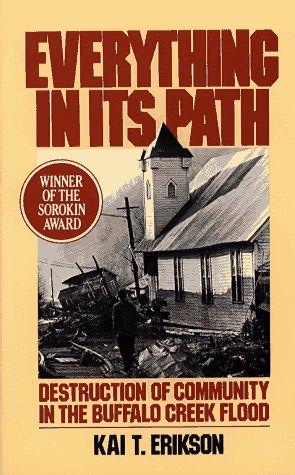
Cover of Everything in Its Path

Everything in Its Path

Kai Erikson

6 ideas

  1. Individual trauma versus collective trauma

    Individual trauma is a sudden blow that breaks through a person's defenses. Collective trauma is a slower blow to the tissues of social life that damages the bonds holding people together and weakens their shared sense of community. The flood caused both, but the collective wound lasted longer and was harder to see, because nothing tangible marked where it was.

  2. Community functions as the self's container

    In Buffalo Creek, people did not experience themselves mainly as separate individuals. Their sense of competence, safety, and identity was stored in the network of kin and neighbors around them. When that network was destroyed, people lost capacities they had never known belonged to the group rather than to themselves: they could not make decisions, trust others, or feel secure.

  3. Trailer camps that scattered surviving neighbors

    The camps met material needs, but they finished the social destruction the water had started, because they stranded people among strangers. Well-meant relief that ignores social geography can do lasting harm that looks like the disaster's aftermath.

  4. Disaster as indistinguishable from its aftermath

    Survivors did not experience the flood as a single event that ended when the water drained away. The disaster continued in the loss of neighbors, the confusion of relocation, and the collapse of routine. When relief and recovery are organized as if the catastrophe had a clear endpoint, they misread the actual injury.

  5. Human-made disasters corrode trust more deeply

    The dam that failed belonged to the Pittston Company. Because of that, survivors experienced the flood as a betrayal by people who should have protected them, not as an act of nature.

  6. Reading culture through its disruption

    The rules of a way of life are often invisible until something breaks them. By studying what people lost and grieved after the flood, Erikson reconstructs the unspoken structure of Appalachian mountain culture: its tension between self-reliance and dependence on others, its fatalism, and its kinship ties. Damage serves as a diagnostic tool, showing which structures were actually holding weight.

Save and mark ideas in the app