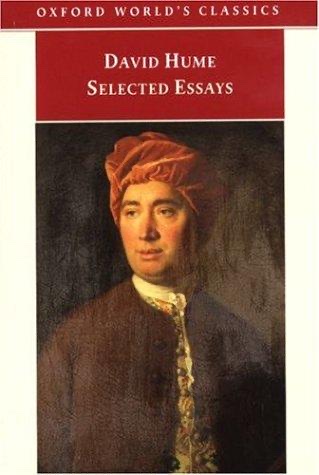
Cover of Essays

Essays

David Hume

5 ideas

  1. Specie flow self-corrects trade balances

    If a nation's money stock suddenly shrank by four-fifths, its prices and wages would fall. Its goods would become cheap abroad and foreign goods dear at home, so money would flow back in until prices matched those of its neighbours. Money finds its level between trading nations the way water does between connected vessels, so mercantilist hoarding of gold and fear of an unfavourable balance are self-defeating.

  2. All government rests on opinion

    The governed always outnumber the governors, so force is always on the side of the many. Rulers therefore stay in power only through opinion: the belief that the regime serves the public interest, and the belief that it has a right to power and property. This holds for the most despotic military regime as much as for the freest, because even a tyrant must command his soldiers by their opinion.

  3. The original contract is historical fiction

    Almost every actual government was founded by usurpation, conquest or both, not by a promise. Tacit consent is illusory, because a poor peasant cannot choose to leave his country any more than a man carried aboard a ship while asleep can choose to leave it mid-ocean. We obey government because society cannot survive without it, and that duty of allegiance stands on its own utility rather than on any prior promise.

  4. Sancho's kinsmen taste the hogshead

    In Hume's retelling from Don Quixote, two of Sancho's kinsmen are asked to judge a hogshead of wine. One says it tastes of leather and the other of iron, and both are mocked until the cask is emptied and an old key on a leathern thong is found at the bottom. Hume uses the episode to show that taste has a real standard: judges with fine, practised and unprejudiced discernment detect qualities that are truly in the object.

  5. Refinement in the arts strengthens nations

    Luxury in the sense of refined enjoyment makes people industrious, knowledgeable and sociable. It draws labour into manufacturing that the state can redirect to soldiers and taxes in wartime, so commerce raises public power instead of sapping it. Commerce also creates a middling rank of merchants who support liberty. Luxury becomes vicious only when it consumes resources needed for duty or charity, and banning it would breed idleness, a worse vice.

Save and mark ideas in the app